Plans change again…

October 4th, 2005

I’ve just had a call from the operations office at BAS, confirming my flight details. I’m now definitely flying on the MOD flight from Brize Norton via Ascension, but my departure’s been put back to the 25th October.


More training…

October 3rd, 2005

The last few weeks have gone by in rather a blur. I’ve spent a week in Cambridge taking my Air/Ground Radio Operator’s Certificate of Competence, which entitles me to talk to aeroplanes at small airfields (a lot of “Golf Alpha Bravo, runway is two six left-hand, wind three one zero at two six knots” and very little “negative, Ghostrider, the pattern is full”!). This was followed up by a day’s course on operating a hydraulic platform (“cherry-picker”) and four days in Redhill learning about Inmarsat-B and repairing HF radios. That’s almost all the training over with! I now have a £700 expense claim from all the travelling I’ve been doing and a big wodge of notes and certificates.

Today I dropped into the operations office to find out if my flights have been confirmed. They haven’t, but I’m now supposed to be going to Stanley on LAN Chile from Heathrow instead of by RAF flight from Brize Norton. This is a very circuitous route! You fly from London to Madrid, then from Madrid to Santiago, then from Santiago to Stanley the following day on a plane that calls at Punta Monte and Punta Arenas. But the plan may yet change again…


Field Course

September 15th, 2005

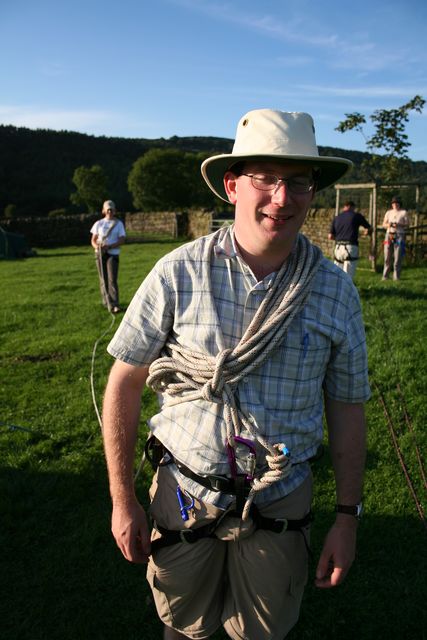
I’ve just returned, sweaty and tired, from the Field Course in Derbyshire. And, yes, I have had a bath before writing this! All the winterers and people who’ll be working away from the bases attend this course to learn about living outdoors in the Antarctic. We’ve learned how to erect one of BAS’s large pyramid tents, how to do alpine-style “linked travel” when walking on glaciers, and how to use a Primus stove and Tilley lamp (these are the classic paraffin-and-meths jobs: modern lightweight camping gear doesn’t survive the harsh environment!).

Pyramid tent at sunset

Linked travel
Practising linked travel

We’ve also been out on the cliffs of Curbar Edge learning to abseil, jumar (climb a rope using a sliding cam device) and prussik (climb a rope using two bits of “string”). We also had to wander round look for a lost person in a white-out – we wore blindfold goggles to do this, and caused much amusement to passing tourists, and we managed to navigate using a compass and dead reckoning. Derbyshire doesn’t seem like much of a substitute for the frozen wastes, but the techniques we learned here in the (relative) warmth will be reinforced with more training when we arrive at Rothera.

Jumaring
Jumaring – I’m climbing the rope, not the rock…

People lying on the floor, asleep..
Another hard day at the office!

More photographs from the field course


First aid – or field medicine?

September 11th, 2005

The First Aid course runs after the BAS conference, and is quite possibly the most intensive training I’ve ever done. In three days you learn everything you’re likely to need to know if you have to treat an injured person in the field, or on base if the Doctor is away or incapacitated. This isn’t the kind of do-gooding stuff I’d learned before: this is intramuscular injections, plaster casts, chest and abdominal examinations, nasopharyngeal airways and nitrous oxide! All this plus the usual treatment of surface wounds, burns, basic life support (CPR) and how to deal with spinal injuries and carbon monoxide poisoning. I learned a huge amount (including that breathing Entonox – nitrous oxide and oxygen – makes me feel unpleasantly like being drunk) and passed the end-of-course exams without too much difficulty. I can see my copy of the BAS medical manual being useful well beyond my time in the Antarctic!

Next week, I’m on a field training course in Derbyshire, followed by a week of air/ground radio training in Cambridge. More updates should follow when I’m in Cambridge!


Information overload

September 11th, 2005

Firstly, my apologies for having not written anything for at least a month – I’ve been really busy, mostly away from home, and almost always without my laptop. As I write this, I’m in an internet cafe in Cambridge, having finally had a spare day to sit down and write…

Anyway, here’s what I’ve been up to:

  • I went to Edinburgh to take the Marine Long Range Certificate course
  • Whilst there, I took in the delights of the Fringe and went flying in a microlight with my uncle.
  • I went to Maidenhead (woo!) for a Novell Netware administration course, which was unremarkable but useful
  • I went to Aberdeen for a satellites course

After all that, I’ve been in Cambridge for the last week, for the BAS Briefing Conference and First Aid course. The conference is basically a big get-together for all the people going South this season – it’s a chance for everyone to meet one another and you learn a huge amount about how BAS works and how to live in the Antarctic. It’s then followed up by a very intensive First Aid course, run by the BAS Medical Unit, who are based at the A&E department of Derriford Hospital in Plymouth. More on this later…

The first big surprise of Conference was that your pack of essential bumf contained a travel schedule: and I’m going earlier than I’d previously thought. In fact, my departure date is October 20th, flying from RAF Brize Norton to Stanley in the Falklands. I’m then due to stay in Stanley for ten days and then transfer to Rothera on November 1st. However, it’s likely that I’ll end up delayed by weather, so I could be in the Falklands for several weeks!
I think I might actually be doing some work in Stanley – there’s talk of doing some radio operations and flight following in the control tower at Stanley Airport, which will be useful experience.
I’ve now met most of the team that’ll be wintering with me at Rothera – we all seem like a good bunch – and there are two people staying on for a second winter. In all, there’ll be twenty-one of us. I’ve also met two of my three radio operators – we’re being loaned two trainee pilots from the Royal Navy, Mark and Owen, and they’re going to be spending half their time doing radio ops work, and the other half doing ground crew and co-piloting duties with the Air Unit.
We’ve also had to order our booze for the winter: 1000 units each! I’ve ordered 3 cases of each of Lancaster Bomber, London Pride and Bishop’s Finger, 1 case of Boddingtons, plus some whisky, gin, port and wine.
My other discovery is that I’ll probably be returning later than I’d thought. I’ve told most people that I’m leaving at the end of February 2007. In fact, I’m likely to be staying until Last Call, in mid-March, and returning to Stanley on the RRS Ernest Shackleton. This introduces a further dilemma – if I stay out of the UK until after the tax year begins on April 6th, then I’ll be able to claim the lower British Antarctic Territory rate (currently 7%) of income tax, so it looks like I’ll be taking a holiday in South America before I return to the UK…

Mast building

August 17th, 2005

The second part of the climbing course involved building a 15m mast in the yard in Cambridge. The mast itself comes in 2.5m sections which get bolted together. Starting with the first two in place, we climbed up and hoisted a new section into place, then bolted it on.
 To keep it upright, there are six stay wires that get anchored and tensioned. These attach every three sections, but it’s not safe to climb more than two unstayed sections, so we had a set of temporary stays to attach instead. We built the whole mast in just less than one day – Kirsty and I topped it off with the last section.
The following day was spent doing rescue practice. Mike, our instructor, had brought the lovely Buffy up from Taunton and we had lots of fun retrieving her. Then it was time to take it all down again!


Warm clothing

August 14th, 2005

When people find out that I work for BAS, they quite often say “isn’t it really cold there?”. The answer is of course, yes, but you can always wear more clothes! Now I’ve found out exactly how many more clothes: I went to the stores to check over the clothing I’ve been issued. Two big bagfulls of stuff were dragged out of the racks, and I went through them trying them all on. Certain things, like the eight pairs of thick woolly socks and the balaclava, were expected. Other things – such as the kind of giant fleecy babygro suit with no sleeves – were less so! Trying it all on took about an hour-and-a-half. Anyway, here are a few of the things in my bags:

  • Dryflo underwear – long-sleeved teeshirts and leggings – the fabric draws sweat away from you by capillary action, so you don’t get sticky.
  • Moleskin trousers – these are combat trousers with a kind of combed-cotton finish, and are warm and hardwearing
  • Ventile jacket and trousers – Ventile is a fabric made from cotton which is windproof, lightly waterproof and very breathable and hardwearing. Because it’s made from the topmost quality cotton fibres (only 4% of the crop is suitable) it’s very expensive. It was originally developed for survival clothing for the RAF in WWII, but has been the choice of British Antarctic expeditions ever since.
  • Thirteen pairs of gloves! Every kind you can imagine: big mittens for skidoo-driving; fine-fingered gloves for delicate work; heavy leather-palmed rigger gloves, rubber waterproof gloves, fleecy gloves and so on.
  • Three pairs of boots: plastic walking boots that take crampons; insulated safety boots and mukluks. Mukluks are Canadian felt-lined boots that come up to mid-calf. They have a separate lining: you get issued with a spare one and are supposed to swap them over each day to stop them rotting!
  • Eye protection: one pair of skiing goggles and one pair of (prescription) glacier-grade sunglasses. These have side pieces so that they don’t allow any light to leak around their edges and make you snowblind.
  • And finally, a black woolly hat with the BAS logo!

Mast and tower climbing

August 5th, 2005

Phew! I’ve got home and am recovering from a busy week in Taunton on a climbing course. We have lots of tall structures on the bases, mostly carrying comms and metereological gear, and so a whole bunch of us got sent down to Western Power in Taunton to learn to climb towers and work safely at height. The other six people on the course are all going to winter at Halley – they’re an interesting bunch and we became good mates over the week.
We spent most of the week climbing the electricity pylons on the training field – there are four different ones – and doing various tasks. So we rigged and de-rigged a mobile phone antenna and did tower rescues: abseiling down to rescue a casualty and lower them safely to the ground.
Now I’m not a natural climber, so I found it quite challenging. I found that my confidence improved with practice, and having a job to do whilst up high is much better than just climbing up for the sake of it.
This morning, to round off the course, we climbed the communications tower, which is 62m (200ft) high, and which has a vertical ladder up the centre. It’s a long, long way! My arms hurt on the way up, although I did reach the top and managed to relax and enjoy the view. Going down, however, was much more difficult. The tower’s fitted with a fall-arrest system which consists of a clamp that slides along a rail, and this will tend to jam unless you get yourself in exactly the right position, which involves leaning back off the ladder with your arms out straight. I didn’t have the strength, stamina or confidence to do this and had to come down much more slowly, moving the clamp a metre or so at a time. It’s one of the most physically demanding things I’ve done, and although I’m glad I did manage it, it’s not something I’d do again lightly!
There are some slightly grotty phone pictures of the course on my moblog site
Next week I’m in Cambridge, where we’ll do the second part of the course – putting up and taking down a 20m guyed mast.


A quiet week in Cambridge

July 27th, 2005

This week, I’m mostly supposed to be doing IT training, in a kind of informal way, with BAS’s IT staff. They’re a nice bunch, and I’m now aware of how Novell NetWare works, and how the Antarctic Message System transfers email between Cambridge and the bases. AMS goes back to the days before the permanent satellite link to the bases, and was originally designed to queue all the email and then exchange it over a £6/min Inmarsat dialup link twice or three times a day. Now it just acts as a buffer between the Cambridge GroupWise system and the local GroupWise email systems on each base.

I’ve also had a chance to play with a field-portable HF radio we’ve got on loan from a manufacturer. It’s a possible replacement for the old military sets we use at present. I took it back to Girton College last night (I’m staying at Girton this week) and had a listen to the amateur bands – I heard contacts from Moscow and (I think) South Africa – so I reckon the receiver’s all right. The reviews on the ‘net by enthusiastic amateurs suggest that it’s a good durable radio and I reckon it’ll probably suit us. Anyway, Chris (my boss) is back in tomorrow and we’ll see what he makes of it.

Girton College is a strange sort of place – a big Victorian neo-Gothic pile in red standstone. I reckon, having once been an all-women’s college, that it may have been the inspiration for Castle Adamant, the all-women’s university in Gilbert & Sullivan’s operetta Princess Ida. It certainly looks the part with its tall conical tower and pointed arches. It was built in 1873, and Ida premiered in 1884, so it’s possible! My room is long, thin, and furnished with the kind of unstylish, well-worn furniture common to old student rooms everywhere. Staying at Girton has turned out cheaper than I’d originally expected (£15 a night!) and the food is really pretty reasonable indeed. Breakfast is copious and the evening meals are pretty good too, and at around £3, very good value.

Girton’s also hosting part of the Cambridge Shakespeare Festival at the moment – a performance of The Tempest is being held in one of the quads. I’ve not seen it yet, as the weather’s been inclement and I’ve somehow managed to be busy at the time when it starts. Maybe tomorrow.


RGS exhibition: “With Scott to the Pole”

July 22nd, 2005

Today I biked up to Kensington to the Royal Geographical Society’s shiny new building – it’s in Exhibition Road, next to Imperial College and the Albert Hall. They’ve got an exhibition on at the moment called “With Scott to the Pole” – it’s a small selection of the photographs taken whilst on Scott’s ill-fated expedition to the South Pole from 1910 to 1913. Most of the pictures were taken by Herbert Ponting, who was the official photographer. It’s a really excellent selection – you see the domesticity and the heroism of the explorers side by side. The pictures are accompanied by notes, usually including quotes from present-day explorers (Ranulph Fiennes, Mike Stroud, Pen Hadow, etc) and scientists talking about how Scott’s expedition pioneered a lot of the techniques still used in the Antarctic today, and how the scientific data they so painstakingly collected is of great value today in assessing climate change.
If you’ve got time, go and see it. It’s on until the 31st July. If you haven’t got time, the RGS’s archive of Antarctic pics is now online, including all the pictures from the Scott expedition.