Black bottoms and hot water

November 27th, 2007

This is the long saga of Innocenti’s recent trip to Earith for some maintenance work. When I bought the boat, the hull was quite shabby and the paint was scraped off in many places, and so I knew that it would have to be repainted fairly soon. This is quite a big job – the boat has to be craned out of the water – and so it’s also an ideal time to do other maintenance jobs that are best done by a boatyard. Anyway, on the advice of several of my boaty friends and neighbours, I booked in at Westview Marina in Earith, and took the boat down there two weeks ago. Earith is quite a long way from Waterbeach – about six hours cruising time – and with the short winter days it would be tricky to do in one go. On the outward journey I stayed overnight at Stretham.

The straightforward work was done pretty quickly. Innocenti was craned out of the water and then pressure-washed off before the old paint was removed with scrapers and then sanded down to give a good base.
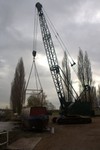
crane
The crane at Earith

hull waiting for paint
Scraped down and ready for paint

It was also clear that the anodes needed replacing, so the old ones were cut off and four new ones welded on. Anodes are lumps of magnesium which act as “sacrificial protection” for the boat’s hull – because magnesium is more reactive than iron, it corrodes away first, ensuring that the hull has a longer life.
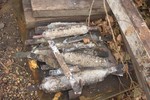
old anodes
A heap of old anodes awaiting disposal

new anode and propellor
One of Innocenti’s new anodes

Another much-needed job was to clean out the freshwater tank. This is under the foredeck, and is integral to the hull. Every few years it should be cleaned out and the inside repainted. Judging from what Graham and his team found inside – lots of rusty sludge – this hadn’t been done for quite some time! Whilst cleaning out the tank (a horrible job in a confined space) was fairly straightforward, getting the paint to go on and dry in the cold and damp November weather proved to be virtually impossible. Graham wasn’t satisfied with the result, and said he wouldn’t try to do one again in wintertime – so the boat will have to go back in the summer for the job to be finished off properly.

Anyway, with this unforseen problem, the boat was in the yard for a week longer than planned. I made arrangements to go and collect it this weekend – and as it happened, I’d arranged for several friends to come and see me that weekend, so we planned a day out on the river to bring the boat back to Cambridge.

Things began to go wrong at this point. I got a cold during the week, and had two-and-a-half days off work being snivelly and wretched. By the Friday afternoon, when Chris came to pick me up (I’d been staying with Rob, who very kindly allowed me to occupy his spare room for two weeks) I was feeling better but still snorting and sneezing. We got to the marina and found out that with the paint still only tacky dry on the water tank, we were going to have to live off bottled water for the next 24 hours or so until the paint dried and we could fill the tank. Then the tank would have to stand for four hours (to soak off any nasty compounds from the paint used) and drained, before being refilled with fresh water.

At this point we went to Huntingdon to pick up Dave from the station, and elected to have dinner in an Indian restaurant rather than eat on the boat with no water. We spent an uneventful night on the boat, and then on Saturday morning Chris went to pick up Gemma, who’d driven up from London that morning and who was leaving her car in Waterbeach so that we could use it to collect Chris’s car from Earith later in the day. I went to pay the boatyard bill, got the boat going and filled up with diesel. At this point we discovered (having not actually checked, stupidly) that the Great Ouse (which is large and fearsome at Earith) was in full flood. Manoeuvring away from the diesel pump was quite exciting, but we set off down the river the half-mile or so to Hermitage Lock, where we could escape the flood of the Great Ouse and go down the much quieter and smaller Old West River. As we approached the lock the engine temperature gauge shot up. This is never a good thing! As the engine kept plugging on, we stopped at the landing stage, woke up Keith the lockkeeper (who hadn’t had a boat through for three days with the river in this state) and locked down into the much safer Old West River. At this point we stopped on the lock-mooring and looked at the engine. One of the rubber parts of the cooling system had split, and steam was escaping somewhat vigorously. This put an end to our get-home-in-one-day plan – even though I (fortuitously) had a spare part, by the time the engine had cooled and I’d fitted it it would have been too late to get to Waterbeach before dusk. So we drank tea, ate Jaffa Cakes and decided to go to Ely for a pub lunch (steak-and-kidney pie, mmm!) and a look around the Cathedral, which is pretty stunning.

Chris dropped me back at the boat later in the day, and everyone went their separate ways.

On Sunday morning I got up early and changed the part in the engine. This turned out to be quite straightforward, although to refill the engine needed pretty much all my bottled water, so it was fortunate that the ever-helpful Keith was able to refill them from his kitchen tap. I fired up the engine and headed off. An hour or so downriver, the temperature gauge shot up again. This didn’t look good. I managed (eventually) to get the boat in close to the bank on a slight bend, and it went aground. This is quite common – the Old West River is shallow at the edges and it’s often difficult to moor, even at some dedicated mooring sites.
Looking into the engine bay, I find that the lubricant I applied to the rubber part to make it go on easily has worked too well – the engine has shaken the part off again, and I retrieve it from the bilgewater. Now what to do? The engine is hot, I’m short of time and short of water. I refit the part again, and attempt to refill the engine using water I’ve heated on the stove (putting cold water into a hot engine can crack the engine block) as I can’t really afford to wait for it to cool down.

Off we go again, only to stop another quarter-mile downstream with an overheating engine again. Now I’m out of water completely, so I fill my rucksack with the empty water bottles and trudge off along the floodbank – the guidebook shows a small marina and a pub less than a mile away. In fact, just around the corner I see another narrowboat moored up – the kind people of “Straight and Narrow” take pity on me and fill my water bottles. They’re going back to Earith, so they say they’ll shout as they pass me on their way back and check I’m all right.

I go back to the boat, wait for the engine to cool down, and top it up again with cold water. It’s now 1530, and with the light fading, I attempt to motor on the short distance to the Twenty Pence Marina, where there’s an overnight mooring and water supply. On approaching Twenty Pence the engine overheats again, and I hastily manoeuvre into the bank, going aground at a rather jaunty angle and manage to secure the boat. A sign says “Overnight Mooring £2” and “Water 50p”, so I trudge over to the owners’ house to pay me fees. Apparently the water pipe to the riverside froze during the hard frosts and split, so there’s no water available, although he does offer to fill my bottles. I trudge back to the boat, cook some dinner and have a long ranty phone call to my parents about the possible problems with the engine…

On Monday morning I go round to the marina owners’ house for water. It’s deserted – they obviously work elsewhere – so I go round to another house nearby and fortunately manage to obtain some water there. I refill the engine again, this time taking note of some advice Dad had found on the internet: it’s very easy to get airlocks in the engine cooling, particularly if you fill it in a hurry. Once you think you’ve got the engine full, start it up in fast idle with the filler cap off, then watch and see what happens to the coolant level. Sure enough, it dropped off after about three or four minutes, and I topped it up again. Once it stabilised I put the cap back on and left the engine in fast idle for ten minutes or so to check it was happy. It was, fortunately, so I poled off the gravel bank I’d gone aground on and headed off home. I arrived back at Waterbeach at around 1400 on Monday afternoon.

Then came the water tank saga. I’d still not been able to fill the freshwater tank, so this morning I motored down to Cambridge and filled it up, then tied up on Jubilee Gardens before heading over to the local branch of HSS to hire a large water pump – thanks to the magic of Streetcar I was able to hire a car in central Cambridge for the hour or so I needed to pick up the pump and bring it back to the boat.
I did try turning on the boat’s water system briefly, and was somewhat crestfallen to discover that the water pressure was even worse than before the tank was cleaned – I’d hoped that cleaning the tank would solve the problem with the low flow rate through the pump.

This evening, having left water in the tank for the whole afternoon, I emptied the tank with the HSS pump and then clambered into the tank to investigate the flow rate problem. This isn’t fun – the tank is only about 35cm deep, and the access hatch is only just big enough for me to get inside. Anyway, I found that the outlet pipe was blocked with a plug of rust, and with much poking and scraping was able to clear it. Tomorrow I shall refill the tank and I very much hope to be operating at full capacity again. Five days on the boat without running water has been rather unpleasant.

It’s all been a bit of a long saga, but it was definitely character-building rather than enjoyable…

Pictures at long last

October 29th, 2007

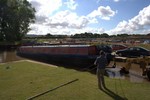
Here are the pictures from the trip – sorry it took so long!


One month in…

October 29th, 2007

So, the PhD’s been going for a month, what have I learned?

  • Freshers’ Week as a postgrad living in a B&B is dull as ditchwater – you barely see anyone in the evenings.
  • Access to journals online when you’re away from your University is patchy. Some work with the marvellous ATHENS system, but others just refuse to work off-campus(IEEE Xplore, I’m looking at you)
  • Cambridge University Library will let you use its computers/wifi to gain access to electronic journals
  • It takes two hours to get to work by bus from Waterbeach, mostly because of the huge queue for the A14
  • Cycling to work is good, and takes about 45 minutes
  • Cycling home from work in the rain results in being covered in fine grit from the towpath
  • It takes ages to get an office at BAS – I still haven’t got one of my own yet!
  • BAS kindly bought me a new laptop to work on. Woo!
  • The domestic battery on Innocenti is even more knackered than I’d thought.
  • The battery selector switch on Innocenti actually parallels the two batteries in all positions other than “off”
  • The new pumpout facility in Cambridge now costs £3 – it was free before the refurbishment
  • The coal stove can actually heat the boat effectively, but the chimney doesn’t draw very well because it’s too short and too narrow.
  • Rowing eights sometimes arrive at Bottisham Lock at 8am, just as I’m leaving to go to work

I’m getting there, slowly!


Boaty update

September 15th, 2007

Sorry for the long delay on this one, but life’s been quite hectic. I got to Cambridge okay, thanks to the sterling efforts of my many friends and relations who helped out. A few high- and low-lights of the trip:

– being in Birmingham when it was “dead sunnay” and mooring up right in the city centre
– getting stuck behind the steam narrowboat “President” on the Birmingham & Worcester canal and helping unstick them when they went aground (which was quite frequently!)
– getting eggs thrown at the boat from a bridge somewhere near Stafford
– finding that the River Nene is mostly boater-hostile (nowhere to moor, nowhere to pump out)
– finding that the Middle Level is very nice indeed, despite being as flat as a pancake. Upwell and Outwell (where the river forms a “high street” through the villages) are very pretty.
– scary stuff – going on the tidal Great Ouse from Salters Lode Lock to Denver, against the wind and tide, for about 500 metres
– getting the propellor fouled on the Great Ouse and then getting blown into a bank of reeds we very nearly didn’t get out of
– having a nice time in Ely (very pretty)

Having arrived in Cambridge, the Mooring Question has reared its ugly head. Various friends and colleagues had advised me that getting a mooring in Cambridge wasn’t all that difficult, but did require some patience and dedication. I’m on the waiting list for an “official” council mooring permit which will allow me to moor against one of the public parks and commons in the city. Until then (probably April, according to one well-connected source) I need to put the boat somewhere. I started on a 48 hour visitor mooring, then found an empty bit of Stourbridge Common that didn’t have a “permit holders only” sign. On Friday I got a hand-delivered eviction notice from the council, telling me politely to get off their land. I’ll go back to the visitor mooring on Monday and then ring around downriver until I find somewhere…


The journey begins

August 17th, 2007

Last Sunday we set off. With full tanks of diesel, water and gas, we motored off into the Lancashire drizzle, heading for Wigan. In fact, we all got pretty soaked up the eight locks to the junction with the Leeds & Liverpool canal at Lathom, but then the weather improved in the afternoon and we made our way into Wigan in glorious sunshine. There were, inevitably, a few minor mishaps. I directed Dave into a disused lock at one point, who then had to back out into the main canal (tricky!), but the major incident of the day was in Wigan, where a group of lads had warned us of an obstruction in the canal. Sure enough, a large plastic tarpaulain was floating in the lock. I warned Richard to look out for it, but he didn’t see it in time and it went in the propellor, stalling the engine. Fortunately, we could drag the boat out of the lock by hand and clear it easily through the weedhatch. We didn’t like the look of the overnight moorings in Wigan, so we motored on to the Dover Lock Inn at Abram, just outside the town. Unfortunately, in locking up for the night we managed to break the cabin door key, which seemed rather alarming. We left the door open overnight, reckoning to get a new door lock in the morning.

Monday was a mostly dry day with the odd shower or two, and we had a gentle run into central Manchester, stopping to pick up Susz for a few hours and also to do various bits of shopping, not least look for a new door lock. A visit to Leigh gained us a new mop, a dustpan and brush and some chocolate muffins, but sadly no doorlocks the right shape. So, three engineers dissected the doorlock on the kitchen worktop and realised that if we removed half the door lock mechanism it would still lock from the outside with the broken key, and then Richard manfully filed and tweaked various bits of the mechanism to make it work more smoothly. After stopping at B&Q in the Trafford area of Manchester for some washers needed to mend the lock, the throttle handle came off in Dave’s hand – not actually off completely, but such that it no longer worked the way it was intended! We sorted that one out in Manchester – turns out that a single screw holds the handle on and it had come loose.

Tuesday was a hard, wet day. The legendary Mancunian drizzle, punctuated by sharp showers, accompanied us all the way to Ashton-under-Lyne, through 27 locks. We were knackered, wet, and very glad of Swedish meatballs in the Ikea cafe!

On Wednesday morning we went and bought a dining table and chairs in Ikea, as well as some more food and various boaty bits from a handy chandlery. The furniture process was pretty straightforward – buy the stuff, get a cab back to the canalside, load it onto the boat and then head off up the canal. Sadly, when I unwrapped one of the chairs it was broken, so it’ll have to go back… gah!

We picked up my semi-cousin Chris in Marple, who helped us up the flight of sixteen locks, and then came with us all the way back to Macclesfield (a very late finish, that one, racing the darkness down the canal looking for somewhere deep enough to moor!) where we had a late night family reunion with Alison (Chris’s mum) and the family.

On Thursday we had a gentler day, taking my “Auntie” Jackie down from Macclesfield to Oakgrove, where she treated us to lunch in the Fools Nook, which was lovely and full of lunching Cheshire ladies. I think we halved the average age of the place when we came in! Then Dave and I pressed on to Congleton, passing through Bosley Locks, which is where years ago my Grandpa took me to watch the boats and where I first became interested in canals and boats…
That evening we put the dining table together and managed a civilised meal in the cabin!

Today we’re going to Kidsgrove, where the Macclesfield canal meets the Trent and Mersey. We might go on down towards Stoke and Stone tomorrow, depending on how we get on. However, Dave’s leaving me tomorrow and so I’ll be crewless until Friday, unless anyone wants to come and lend a hand?


The first few days afloat

August 10th, 2007

I have bought the boat, and am living on it amidst a sea of old paint tins, random clothing and wires spilling from most locations around the cabin – there’s very little fitted storage on the boat.
Anyway, there now follows a potted summary of what I’ve been doing for the last few days.

Tuesday
I picked up my hired Nissan Note from Portsmouth and drove up to Lancashire in the afternoon, and stayed in the Original Farmers Arms at Eccleston, a pub that does B&B. I was curious about the name until I turned into the car park of a pub called the Farmers Arms in Heskin, a village about a mile south of Eccleston…

Anyway, I had a dinner of steak-and-kidney pie, followed by apple pie and custard. Mmm…pie!

Wednesday
In the morning, I fortified myself with tea and toast and drove to St Mary’s Marina at Rufford, in time to see “Innocenti” being pulled out of the water on the slipway trailer and trundled into the rather nice new boatshed.
boat on slipway
Innocenti on the slipway

Shortly afterwards, the surveyors, Paul and Duncan Rutherford, arrived from Bolton. They’re a father and son team – and they got to work pretty quickly, marking the hull of the boat with chalk every three feet and then scraping off areas of accumulated grot and paint to get at the hull. They used an ultrasound probe to measure the hull thickness, and then moved on to inspect the engine bay and cabin. As they went along they gave me some hints as to what they’d found. At the end of the session I was pretty happy with the state of the boat – there were a few minor things to sort out right away, and some longer term improvements to make, but basically the hull and most of the systems were in good shape. Unfortunately the engine wouldn’t start – the battery was tired. Bob (who seems to run the Marina more-or-less singlehandedly) leant me a charger to try and put some life into it.
I met Mark (the vendor) and closed the deal, and then rang the bank. I’d originally intended to pay by a CHAPS instant transfer, which costs £25 but clears very quickly. The bank, however, insisted on a faxed authorisation for this, which wasn’t going to be easy. Instead, I opted to pay by bankers’ draft, which meant going to Wigan, the nearest town with a branch of my bank.
I agreed to meet Mark the following day with the money, then dashed off to Tesco’s to stock up with food! I spent the night on board for the first time, although I was still disappointed by the lack of a running engine…

Thursday
…was very hectic. I jumped in the car and went to Wigan to do some shopping for essentials and go to the bank. I spent a long time driving round and round the town looking for Halfords, only to happen upon it by accident as I was on the point of giving up looking! Returning with a bootful of kitchen bits, a new headlight, some spanners and a hose for filling the water tank, I stopped briefly at Lathom and handed over the draft to Mark. We shook hands and went our separate ways. Then there was a minor race against time. I had to return the hire car to Wigan by 5pm, but was increasingly of the opinion that only a new battery would solve the non-starting engine. Back to the marina and the omniscient Bob has the answer – pop down to Trafford Brakes in Burscough – five minutes down the road – and get a new one. I do this, having carefully measured the battery to ensure that the new one fits in the tray. On returning triumphantly, I find that the battery won’t fit in the tray by about a millimetre… but the engine roars into life and some life returns to the domestic electrics. But I can’t hang around – I have to lock up and drive back to Wigan to return the car. In this case, fortune smiles on me – I walk out of the car hire office, go round the corner to the station and get a train right away back to Rufford and cook myself some dinner!

Friday
This morning I had various odd jobs to do. I wanted to fit the headlight (actually a car exterior foglight, acquired from Halfords yesterday) which will be needed for the tunnels we’ll pass through en route. Having bolted it onto the boat – there was a convenient hole where one had been mounted before – I found that I needed crimp terminals to connect the electrics. I also needed glue of some sort to glue some rubber sheeting around the weedhatch to get a better seal, and thought about getting some kind of ratchet strap to secure the battery temporarily. I reckoned I was going to have to go somewhere bigger (like Ormskirk or Preston) to get these, so I walked down to the station to see where if I could get a train. There wasn’t a train for 45 minutes, so I reckoned I’d walk into Burscough, try there, and if not go elsewhere. On the way, I found the Central Garage, a magical local garage and shop. Just inside the door was a rack of car spares and hardware, including the crimp terminals, ratchet straps, Araldite glue and also some Swarfega, which seemed useful given how unpleasant my hands were getting!

new headlight
The magic shop also turned up wonders in the afternoon, when I wanted a small jubilee clip and some washing powder – both were readily available.

So, the headlamp works, the battery is strapped in, but the rubber in the weedhatch proved a non starter – the sheeting is too thick to allow the screws to bite properly, and the glue didn’t bond well to the rubber. I’ll have to work out another way of doing it, but we’ll just drive carefully and keep an eye on it for now. I’m still peeling little bits of Araldite from my fingers…

This evening I have refilled the water tank, done some laundry and fixed the WiFi on my laptop (bloomin’ Microsoft…) so I can connect to the marina’s internet service rather than use the more expensive Vodafone data card. I’ve also received the full survey report by email, and it looks fine. Tomorrow, Dave and Richard (both ex-York friends) will be joining me and we’ll set off first thing Sunday morning. The plan is to be in Wigan on Sunday night, Manchester on Monday night and perhaps Macclesfield on Tuesday. We’ll see how it goes.

Here are some pictures of the boat, both in and out of the water. Note that the first few pics are of someone else’s (much smarter!) boat being put back in the water after a paint job.


A new chapter

August 5th, 2007

Hello again! Since I last wrote the final details of my PhD have slotted into place, and I’m now pretty happy with how it’s set up. There are a few minor things still to get sorted, but it looks like a goer. This means I’m committed to spending the next three years of my life in Cambridge, and so I’ll need somewhere to live. In fact, I’ve decided to buy a narrowboat – and managed to find one I like at a price I can afford. It’s being surveyed this week (probably on Wednesday) and after that I’ll be embarking on a four-week trip from the outskirts of Liverpool down to Cambridge and passing through quite a lot of the Midlands on the way. I’ll be keeping this blog updated with the progress!


Journey’s end

June 20th, 2007

I’ve now been back in the UK for just under two weeks – we arrived at Portland docks bright and early on the morning of the 7th June and I met my parents (and Lowri’s!) on the dockside. It was certainly a marvellous way to come back home – in many ways a lot more special than arriving at Heathrow!

arriving at Portland
Arriving at Portland – more photos
Anyway, since then I’ve been away for a week’s holiday in Cornwall and am now back in my old bedroom at my parents’ house throwing away lots of stuff I abandoned there when I left to go South, and arranging to meet lots of friends and relations.

Everyone’s been asking me what I’m doing next. I’ve applied for a PhD studentship that’s been organised between BAS and Leicester University, looking using modern digital techniques for HF radio. I’m currently waiting to hear whether my application’s been accepted – I’m expecting to be called for an interview at some point in the next few weeks. If I do get it I’ll be moving to Cambridge, and this blog will hopefully chronicle how it all goes. I hope you’ve enjoyed reading about my Antarctic experience – I’ve certainly enjoyed writing, photographing and videoing it – and I’m always happy to answer questions about my time down South.


All at sea

June 2nd, 2007

One or two people have asked what I’ve been doing whilst I’ve been on the ship – but the time seems to have passed pretty quickly. Besides reading, catching up with correspondence and trying to organise mobile phones/accommodation/insurance and other dull things that are needed for life in the UK, we’ve been involved in helping with some of the ship’s work, too. I was fully expecting to be given a pot of paint and told to go and make something look less rusty, but it turns out that painting a ship requires skill, technique and an ability to use the evil-sounding air-powered paint scraping guns, so we’ve been assigned some other duties. Amongst other things I’ve helped to: clean the beer store (hot and smelly), pack away Uta’s instruments and stow them in the hold, test the fire alarms, test the fire hoses, test the fire hydrants and clean and pack away the inflatable boats. I’ve also fixed a few computers, inevitably! We’ve also done lots of drills – lifeboat drill, liferaft drill (complete with an out-of-date liferaft which later was turned into a paddling pool!) a fire drill and a major incident exercise. The ship’s crew have to stay familiar with what to do in an emergency as any help could be several days away.

liferaft/pool
The liferaft, reincarnated as a paddling pool – it would normally have a bright orange cover

There’s also entertainment on board – we had a barbecue on the aft deck to celebrate crossing the Equator last week, and Ags organised a quiz night. Because the ship’s food is plentiful and excellent, we’ve also been doing circuit training (not usually my cup of tea at all!) in the main hold with Rich the Purser, who makes us all work for our supper. Doing certain exercises (notably press-ups and star jumps) on a moving ship is a bit tricky!

waves
Through the Atlantic Ocean

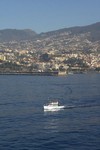
Today we’ve called at Funchal in Madeira to do an exchange of passengers – Uta and Vsevvy have got off and will fly home, and we’ve picked up three engineers who are going to look at the ship’s power systems, part of which are being replaced when it’s drydocked later in the month. Duncan the Chief Engineer very kindly gave us a tour of the engine room last week and explained what this will mean. JCR is a diesel-electric ship, which means that the propeller is driven by two huge electric motors, which are in turn powered by diesel generators. The reason for doing this is that it significantly reduces the amount of engine noise the ship puts into the water – and engine noise can seriously muck up any scientific work that relies on sonar or acoustics. The whole ship is designed to be as quiet as possible and this is noticeable all over the vessel – there’s much less noise and vibration than on the Ernest Shackleton, particularly on the aft deck. The control system that’s being replaced takes three-phase power from the generators and produces a controlled DC supply that drives the electric motors. This system provides the ship’s speed control and reversing, and also couples into the power management system. There are four diesel generators (two large, two small) and the system starts and stops them automatically depending on the amount of power required to drive the ship and power all the auxilliary systems. Anyway, replacing the power control will be a major job and needs to be got right!

first sight of madeira
Ags has her first sight of Madeira

We didn’t actually go into harbour at Funchal – we approached the harbour and then held off out of the way, using the dynamic positioning system to keep the ship stationary (the DP system uses GPS to control the ship’s engines and thrusters and can hold it steady or make it move along a defined course) whilst a boat came out to meet us and transfer the passengers.

approaching Funchal
Approaching Funchal

captain and first officer
“I see no ships!” – The First Officer (Tim) and Captain (Jerry) looking for the transfer boat

transfer boat
The transfer boat, “Scotia”, coming out to meet us


South America pictures

May 23rd, 2007

I’ve finally uploaded my pictures from my jaunt around South America. Here are the links:

Leaving Rothera on the Ernest Shackleton, Lemaire Channel and the Drake Passage

Stanley and Volunteer Point – lots of penguin pics

Saunders Island – lots more penguin pics

Punta Arenas

Bariloche

Tren Patagonico and Viedma

Buenos Aires

Iguazu Falls

Itaipu dam

Rio de Janeiro

Cassino and Rio Grande

Montevideo