Science at sea

May 22nd, 2007

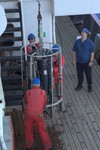
We’ve had a couple of breaks in our journey over the last few days to do some scientific work. Uta Neumann from the University of Kiel joined the ship in Montevideo in order to recover some instruments in the Vema Channel (also known as the Rio Grande Gap), which is a gap in a range of undersea mountains, almost exactly due east of the city of Rio Grande in Brazil (which, coincidentally is the nearest city to Cassino). The region is interesting because warm waters from the tropics pass through the gap into colder waters from further south. Anyway, Uta’s colleagues have had a set of instruments attached to a “mooring” for the last two years – it’s a long cable anchored to the seabed with instruments and buoys attached to it at regular intervals. When it’s time to collect the instruments, the ship sends a coded command to the mooring as a sound signal through the water, and the cable detaches from the anchor and the instruments float to the surface. It takes about an hour for the mooring to come up – they’re a long way down! Once the mooring is sighted (not always easy – occasionally instruments are lost because they get swept away by currents as they come to the surface) the ship’s crew grapple the mooring and pull it on deck.


recovering the mooring

Recovering the mooring


Uta and one of the instruments

Uta and one of the instruments – the yellow blobs are the buoys that brought it to the surface

On this mooring the instruments were making oceanographic measurements – measuring the speed and direction of the currents and the temperature and salinity of the water. To check the data, the instruments (after being downloaded) were lowered into the water on the ship’s CTD instrument (which also measures temperature and salinity) and the data will be compared to make sure that the instruments are still calibrated after two years in the South Atlantic.
Doing a CTD on the ship is like doing one at Rothera, but on a much bigger scale – a large gantry unfolds from the starboard side and the instrument is winched down to the bottom and then back up again. Unlike the one at Rothera you get a real-time readout of the data from the instrument, and the winch is power operated, which is just as well as the sea was over 4000m deep at the site.


the CTD instrument

The CTD instrument being swung out across the deck


into the water

The gantry swings down and lowers the instrument into the water

You can follow the ship’s progress using the magic of Sailwx.info, which uses the ship’s regular weather reports to plot its position.


Cassino Royale

May 18th, 2007

We had a very pleasant few days in Cassino (on the south coast of Brazil, close to the border with Uruguay), staying with Mike and Clarissa at Pousada Blumengarten – a pleasant house/hotel with three cabins in the garden – and they kindly organised a whole range of activities for us. We went to see a local band play at the theatre (good, but a trifle over-technical), took the ferry across to Sao Jose do Norte, rode horses and just generally chilled out. Being much further south than Rio de Janeiro the climate is much more temperate, but we still had plenty of warm pleasant days despite the approach of autumn. And we went kitesurfing.
Cassino is the beginning of one of the longest beaches in South America – over 300km, finishing across the border in Uruguay – and so it’s a popular location for kitesurfers to whizz up and down in the shallow surf, dragged by their parafoil kites. Of course, after just a four hour lesson we were anything but professional, but our enthusiastic instructors Lucio and Raphael gave us a good flavour for the sport, despite the dropping wind. I turned out to be better at this than I was expecting (must have been all those long afternoons flying kites on Butser Hill when I was a kid) and I’m keen to have another go when I’m back in the UK.

On Sunday we made our way to Montevideo on the overnight bus. We elected to stay in the hotel with the ship’s crew (this port call was also a crew change) and headed out to see the city and do some shopping. Montevideo is a major port and the main streets bustle with shoppers buying the latest import bargains. I got slightly carried away and ended up buying more than I’d intended, but on the other hand it’s nice to have new clothes and shoes after almost two years in the same stuff (my last pair of jeans bit the dust in the summer at Rothera) and everything was locally manufactured and consequently cheap and of reasonable quality.
Our retail therapy was cut short by a phonecall from the shipping agent – we were sailing earlier than planned – and found ourselves on the JCR and sailing away at 3pm on Tuesday afternoon, rather than 9am Wednesday as had been the original plan.
Now we’re heading north, and today we’re more or less due east of Cassino, picking up some current meters that have been recording data for the last two years.


Briskly through Brazil

May 10th, 2007

We did go to Rio, care of a 20-hour bus ride from Iguazu, which turned out to be one of the less ideal ones. It took about 2 hours to do the border formalities, and then about an hour over the border the bus broke down, so we had a long wait for a mechanic at a roadside eatery. The bus was “cama” (sleeper – with wide reclining seats) but not as good as others, and there was no onboard food. Bruce and I met up with Ags & Lowri again at a hostel in Copacabana. It was hot. I’d just about coped with Iguazu (25 degrees and very humid) but Rio was 30+ in the shade, with less humidity, but in the merciless sunshine I felt like I was being roasted alive. I managed ten minutes on the beach before having to go back in the shade. This is a shame, as the beaches are indeed very lovely (although Copacabana beach is, like any popular beach, covered in litter and detritus above the high-tide line) and people wander around the city dressed in their beachwear – it’s a big part of the culture. Amongst the bronzed and beautiful (and not so beautiful and still bronzed) people I felt like a maggot – a pallid white thing that had to constantly seek dark places!

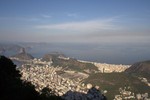
Copacabana and Sugar Loaf Mountain, seen from the statue of Christ
Copacabana and Sugar Loaf Mountain, as seen from the statue of Christ
There is, of course, another side to Rio. The girls did one of the organised favela (shanty town) tours that donates some money to an education project – I’m still dubious about whether these are a good thing or not, after all, I don’t think the residents of rough areas of Britain would take kindly to tourists being shown round, regardless of the income they brought – but you can see the favelas everywhere, clinging to the steep mountainsides all over the city, lacking sanitation and entirely in the control of the drug barons. I don’t think there’s another city where the very poor and very rich live so close together, the have nots and the have yachts.
All that said, the views from the cities many hills and mountains are stunning – so much green forest in the city.

rio at sunset
Sunset over downtown Rio, seen from Sugarloaf mountain

Lots of photos of Rio

Now we’re all in Cassino, a small town and resort on the southern coast of Brazil where the climate is much more to my liking. We’ve met up with another Mike – another ex-BAS guy – who’s staying down here. But the adventure is nearly over – on Sunday night we’re taking a bus to Montevideo and joining the ship.


Iguazu

May 4th, 2007

Iguazu is awesome. The mighty Iguazu river comes charging over a vast assortment of high basalt cliffs and crashes down into the basin below, showering everything in clouds of fine spray.

Interestingly, the river also forms the boundary between Brazil and Argentina, and nearby it joins the Parana river, which forms the border with Paraguay, so the whole region is somewhat international. I´ve so far been to Brazil on two day-trips, which is beginning to fill my passport with stamps!

I´ve seen the waterfalls from both sides – the Argentinian side is more extensive, showing a huge number of individual falls, whereas the Brazilian side allows you to walk out on a catwalk into a bowl where falls crash down around you on two sides. Both are a great experience, as is the little boat from that takes you right up and under the falls, soaking you to the skin in the process! You dry off soon enough…

More pictures of Iguazu
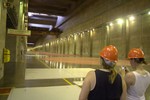
Continuing the aquatic theme, we also went up to Itaipu, which is a vast dam on the Parana river just north of here. It´s on the Brazil-Paraguay border, and is so huge as to defy description. Suffice to say that it´s the world´s largest electricity generation plant – just one turbine produces 90% of all Paraguay´s power. The whole plant can produce 14GW at full capacity, although normally runs at between 12-13GW as two turbines are offline for maintenance.
Throughout the site you can feel the vibration of the rushing water, but whilst we were in the control centre a generator started up and the whole place shook like a minor earthquake, followed by the sound of surging water. Our guide had to swiftly reassure us that this was normal!

turbine hall
Ags and Lowri in the turbine hall

More photos of Itaipu

Tomorrow, Bruce and I are heading to Rio de Janeiro, to meet up again with Lowri and Ags. Only ten days left now until we have to be in Montevideo…how time flies!


Buenos Aires

April 30th, 2007

I´ve had a lot of fun in Buenos Aires over the last few days – it would have been good to stay a bit longer but I´m now increasingly conscious that time is ticking away until the ship sails on the 16th May.
Anyway, I arrived at the bus station from Viedma (a minor epic in itself, involving waiting until 0400 for the bus, then it breaking down and arriving in BA an hour late) and met Alejandro, my friend and ex-medic of San Martin Base, and we went into the city centre to get a coffee and snack. This is my first “big city” experience in a long while and BA in rush hour is full of people everywhere! Anyway, I end up staying the night with Alé and his girlfriend Maria Agustina in her miniature flat in the rather nice district of Recoleta. The following morning I move into a hostel on the other side of town which turns out to be mostly full of Argentinian students studying at the nearby university.

The days pass in a bit of a whirl – I meet Lowri and Agnieszka, go sightseeing, eat lots of excellent food (steak, pizza, empanadas – like cornish pasties, etc) and meet various friends of Alé and Agustinas´and enjoy the Buenos Aires International Book Fair (a vast trade fair, simply enormous – I find reasonably priced English books, hurrah!). Finally on Sunday I´m invited to lunch with Alé´s parents in their apartment on the southwest side of the city. We have a long lunch and plenty of discussion!

Photos of Buenos Aires
Now I´m in Puerto Iguazú, having come on a very comfortable bus last night. Watch this space…


Urban bus rant

April 24th, 2007

I´ve taken a lot of urban buses in the last couple of weeks, and this has resurrected an old rant aimed at bus companies and local authorities.

So, you arrive in a strange town by any mode of public transport. Nine times out of ten you will arrive at an airport/railway station/bus station that is some distance from your onward destination. The city has buses, clearly, but where do they leave from? How often? How much is the fare? Will the driver need exact change? This information is never available in an obvious form in the terminal. This is especially galling when you´re at a terminal for long-distance buses which is (as in Bariloche) 3km outside the town centre!
Similarly, in lots of cities, bus stops are unmarked. Yes, Bariloche and Rio Gallegos I´m looking at you especially. Even in British cities, you usually just get the sign saying “Request Stop” and nothing else. You´re expected to know where the bus goes and how often. In my village there were bus stops for a service that only ran during school terms – how were you expected to know that? If you´re lucky enough to see buses you have to resort to stopping every one that looks promising and asking the driver if he goes where you want. If you´re lucky, he´ll tell you which bus you want in a tone that doesn´t imply that you´re a bloody ignorant gringo/southerner/northerner/tourist.
It gets worse. In most towns here in South America the streets are in a grid pattern with each street carrying traffic in one direction only. So if you get off a bus somewhere, the return leg of the same bus route will be on one of the other two parallel streets, but which one? You don´t know because there aren´t any marked bus stops!
British towns are no better. London actually gets it right, with its very handy Underground-style route maps at every bus stop showing where the buses go and at roughly what frequency. But other cities are lamentable. Cambridge in particular has one of the most actively user-hostile bus systems in the world, particularly if you arrive at the railway station which is, you´ve guessed, over a mile from the city centre.
Bus companies are also fond of highly circuitous bus routes that take you several blocks in the wrong direction before doing a 180 degree turn (Bariloche again) or totally bizaare topologies (like the figure-of-eight bus route that used to run between York University and the Monks Cross shopping centre). The fare structures are often non-obvious and priced to a bizaare level of precision (1.15gbp, say, or AR$1.30) rather than just a flat fare to anywhere on the route (London). This is particularly frustrating where the bus drivers are either snotty about giving change (Argentina generally – there seems to be a national shortage of small change and two peso banknotes) or are panelled in behind security glass and only take exact money (Birmingham and Coventry).
None of this is rocket science, but people won´t take buses unless they either do it every day or they know how it works. Maybe the taxi drivers are conspiring behind the scenes to ensure that tourists find buses impossible to use!


Going loco – not quite the Old Patagonian Express

April 23rd, 2007

I´m in Viedma, a pleasant and untouristy town on the banks of the Rio Negro, close to the Atlantic Coast. Why? Well, the train buff in me couldn´t let this trip pass by without a train ride, and one of the longest ones still running is from Bariloche to Viedma. Argentina once had a very comprehensive rail network (mostly built in the Edwardian period) but that was comprehensively destroyed by privatisation in the early ´90s (sounds familiar!)

Anyway, I´m on my way to Buenos Aires, so rather than do another 30+ hour bus ride, I reckoned I´d do a 15 hour train ride and then a 12 hour bus ride instead. If you look at the handy map of surviving rail services, you´ll see that I could in theory have taken a train all the way to BA – after all, Paul Theoroux did in The Old Patagonian Express. That was in 1978 – nowadays the service from Bariloche to Viedma is run by Tren Patagonico, which is owned by the regional government of Rio Negro province. The service to Buenos Aires leaves from Viedma´s older sister town of Carmen de Patagones, which is on the north side of the river and consequently in a different region and run by a different company. They don´t connect, so I had a choice of spending three days in Viedma and Patagones or taking the bus. I´m taking the bus.

Anyway, my journey began badly on Wednesday afternoon when I went to Bariloche station to buy a ticket. I´d intended to buy a ticket for “Cama” (sleeper) class, but it was sold out, so I bought a ticket for “Pullman” class instead. This was nearly half the price, so I wasn´t sure what I was letting myself in for! My hosts in the hostel, Carlos, Juan and Veronica, reckon I´m loco (mad!) not to be taking the bus instead…
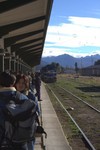
train at station
Waiting for the train…

Anyway, come Sunday afternoon I packed up my bongos and dragged all my baggage down to the station on the bus. The train might be slow and only twice a week but it´s very cheap and there were a lot of people on the platform. When it came in I found my seat in the Pullman coach, which was not quite what I was expecting. George Pullman would probably have objected somewhat to his name being affixed to a coach full of elderly metal seats with wipe-clean blue vinyl covers, but the seats were fairly comfortable and there was loads of legroom.

train interior
Inside the “Pullman” coach

The train leaves Bariloche behind quite rapidly and leads into a Wild West landscape of vast expanses of scrubby Patagonian grassland puntcuated by dramatic craggy rock formations scoured into Barbara Hepworth-esque shapes by the wind. We pass through a couple of stations that serve minute settlements – no-one´s booked to use them so the train won´t stop. Soon it goes dark and I stop looking out of the window. A steward, who could be Jools Holland´s long-lost Latino brother, appears and takes for reservations for dinner in the restaurant car. I agree, and then get the main dishes summarised at high speed in Spanish, out of which linguistic maelstrom I pluck the words for “chicken” and “salad”. He seems satisfied with my choice and beetles off, warning me that he might have to seat me with strangers if the restaurant is busy.

sheep at sunset
Patagonian sheep running away from the train at sunset
Come nine o´clock, four hours out of Bariloche, and dinner is served. The restaurant car is easily the best feature of the train – it´s nicely decorated in the company colours of blue and yellow, with loose wooden chairs just like a proper restaurant. Jools Holland brings me two young chaps to have dinner with – we converse in extremely bad Spanish, very hestitantly, as they speak fast and quietly and I can´t make out what they´re saying over the noise of the train. It turns out they´ve been to Bariloche to buy a second-hand car (they´re both mechanics) and are bringing it back on the train – which has a flat wagon at the back for just this purpose.
We have a starter of cold meats and salad, followed by chicken (me) or ravioli (them) and then “flan”, which is Argentine Spanish for Creme Caramel. Not bad at all for 20 pesos (7 quid) all in.
Whilst we´re eating the train pulls in to the station at Ingeniero Jacobacci, one of the largest on the route and named after the guy who built the line.
This is where La Trochita, the 400km narrow-gauge line to Esquel which Theroux made famous, joins the main network. I can just about make out the line snaking off into the darkness. Sadly, the Trochita rarely comes all the way to Jacobacci these days – only on special charters for railfans.
After dinner, I head back to Pullman (declining my free ticket to see the film “Doom” in the Cine-Coach – another great idea British trains should bring back) and nod off as best I can. Inevitably the train makes two or perhaps three stops overnight, culminating in a long one at San Antonio Oeste at about 0530, where the train reverses.
At 8am we rejoin Jools for breakfast of coffee, toast and a “medialuna” – an Argentinian croissant, very very sweet indeed and then watch the totally flat landscape slip away at the leisurely pace of no more than 50 mph. The line is virtually worn out and the train bounces and rattles over the track, so I´m grateful that we´re not setting any speed records. We arrive in Viedma at 1000, almost an hour earlier than planned. I get a taxi (no obvious buses, of course) to the bus terminal and leave my backpack with the man in the Andesmar bus company office, then walk into town. I completely fail to find the tourist information office and blunder into the commercial district. I sit down briefly in the plaza outside the cathedral to check in the guidebook – and am rapidly deprived of one peso in small change by a scruffy guy with a sign saying he needs new glasses (which is probably believable with the way he´s squinting) and then of five pesos by a formidable lady with two exceptionally dirty and barefoot children, who demands that she needs to buy milk. Not wishing to further remunerate all the vagrants of the city of Viedma, I go back to the riverbank and sit in the sunshine near the ferry terminal, which appears almost entirely devoid of people. I noodle about, watching the canoeists on the river and eventually come across the tourist information centre. The lady is extremely helpful (I´m probably the only person she´s seen all day) and gives me a big wodge of maps and brochures showing where all the sights of both cities are. Looking at the timetable she´s given me I can go to the Historical Museum in Patagones that afternoon between 2:30 and 4:30, then go around to the Coastguard museum at 5, then come back to Viedma on the ferry to see the fascinating sounding Technological Museum of Water and Soil at 6 o´clock. So I had lunch – in a place which contained both a restaurant and a cafe, and got accidentally steered into the restauranty bit by the waiter where I ate ravioli whilst surrounded by smart lunchers in suits – and then took the very jolly little ferry across the Rio Negro to Carmen de Patagones. Despite the fact that the two towns are linked by two road bridges (one of which also carries the railway) there´s a ferry linking the two town centres as it saves you walking almost a mile.
The historical museum is fascinating – in a lovely Spanish-style house which was once the Bank of Patagonia – and the genial curator shows me around and agrees to speak slow Spanish for my benefit. At the back is a cave dwelling, built by the original settlers who were destitute peasants sent here from Spain in the 1790s. The town of Carmen de Patagones was later a port, and succeeded because it´s authorities chose to negotiate and act reasonably towards the native peoples of the region. It collapsed as a mercantile centre once a deep water port opened at San Antonio, on the Atlantic coast. The museum has a fine selection of artefacts from the town´s heyday.
After finding an icecream, I strolled down to the Coastguard building, and as I was early I watched about 8 guys attempt to manoeuvre their boat onto a trailer on a slipway. At first it wasn´t obvious, as the trailer was totally submerged and marked only with bamboo canes, but with a lot of goodnatured shouting and pulling on ropes by coastguards in rather unflattering orange drysuits, they got it in position. Then I asked the guy in charge where the museum was, whereupon he told me it was closed today. So I tootled back towards the ferry, looked into the cathedral (very neoclassical) and then headed to the Technological Museum, which turned out also to be just closing rather than just opening (nil points to City of Viedma Tourist Disinformation!) , but the very enthusiastic lady showed me around their interactive exhibits on water supply and cultivation in the region – lots of cool scale models of hydroelectric schemes and that kind of thing.
Now I´m in a cybercafe killing time until a) it´s a reasonable time to eat again and b) I can go to the bus terminal and wait for my bus, which leaves at 03:00 (thank you, Andesmar buses!). Tomorrow is another day, and Buenos Aires, and my amigo Alejandro, ex-doctor of San Martin base. Hasta mañana!

More photos of the train journey, Viedma and Carmen de Patagones


Back 2 skool

April 18th, 2007

On Monday, I started a Spanish course at La Montaña language school in Bariloche. They´re very friendly and with the weakness of the Argentine peso the course is extremely good value. There are three students in my class, which runs from nine until one every morning (with a half-hour break for coffee and medialunas – Argentine croissants) and Flavia, our teacher, is working hard to help us get our heads around tenses, prepositions and all that jazz.
It´s mostly quite wet in Bariloche at the moment but we are having some good days from time to time. I´m leaving Bariloche on Sunday – I´ve just been to the station and bought my train ticket.


Walking

April 15th, 2007

I’ve now been in Bariloche for five days and seen quite a number of the sights despite rain and high winds – it’s autumn here, of course. I braved the high winds with two Canadians (Jason and Camilla) to climb Cerro Otto on Friday – this is initially an uphill climb on wooded tracks until you reach the access road which takes you to the top. This being a resort town, there’s a cable-car and cafe on the top – both were very shut! We huddled round the back, ate our sandwiches and walked back again.
On Saturday (my birthday) I walked around the Circuito Chico – a pleasant route around one of the smaller lakes. It’s recommended as a bike ride, but I reckoned with the indifferent weather I’d walk and then bail out to a bus if the heavens opened! Anyway, it didn’t rain too much and there are some lovely views, particularly the huge waterfall that comes right down the cliff face behind the Mountaineer’s Cemetery. Unfortunately, most of the fine views of the lake are hidden by trees that stand on private land – but it was still very pleasant.

waterfall
A very high waterfall

Today, with glorious sunny weather and no wind, I’ve been to Villa Catedral, which is the ski resort a few miles from Bariloche – one of the biggest in Argentina. Out of both the ski and main summer holiday seasons it resembles a deserted theme park – but there were still plenty of people mooching about and walking and enjoying the view. I walked up to the snow line, which took about an hour, but didn’t fancy going to far beyond (I was on my own and without mountaineering gear, and I didn’t have a mobile or radio) so wandered back down again and got the bus back to town and a large icecream…

Language school starts tomorrow. I’ll keep you posted!


Bariloche by bus

April 12th, 2007

Mmm…trees! Yes, I’ve made it out of the Far South up into autumn in Argentina’s Lake District. Bariloche is a touristy town and ski resort in the foothills of the Andes. Getting here from Punta was largely uneventful – bus to Rio Gallegos, overnight there, then an overnight bus to Bariloche (26 hrs…). I spent a lot of time looking out at the mostly featureless landscape, watching it slowly change from flat grass to little scrubby bushes and develop some wildlife. Highlights of the journey were the tame guanaco (a llama-like animal) at a service station, which trotted into the cafe and attempted to help itself to sugar from the tables before it was shooed out by the lady at the counter and waking up on the bus to a glorious sunrise over the mountains.
I’m going to be in Bariloche for a while – I’m staying in a friendly youth hostel and have signed myself up to do a week’s Spanish course starting on Monday. This evening I’m going to a wine tasting with some people from the language school. Should be fun…