Easter in Punta

April 8th, 2007

In daylight, Punta turns out to be a bit of a curate´s egg – parts of the city are very scruffy and other areas have shiny new retail shops. It´s also hard to tell on a Sunday which of the businesses are closed permanently and which are just shut today as everywhere has shutters covering the shopfronts. The city´s laid out on a grid pattern and the main traffic routes are wider, with large central reservations that double as linear parks. Unfortunately, although Punta clearly has had plenty of civic pride in the past (there are monuments and statues everywhere) it now seems prone to vandalism and graffiti. The area immediately around the main plaza seems to have been smartened up quite recently. Anyway, this morning I thought that I might go to the service at the cathedral (as it´s opposite my hotel) but it appeared closed for most of the early part of the morning and there was no information as to when the services were held. So I went to the museum instead – which is in a palatial Edwardian house once owned by Mauricio Brown, one of a small number of merchants who became extremely wealthy through wool and whaling back when Punta Arenas was one of world´s busiest ports. When the Panama Canal took away the trade the city never really recovered. Having enjoyed the preserved rooms from the mansion and the exhibition on the history of the city I found the shops open and went in search of a few small items. When I was done I wandered back into the plaza to find that a curious roped-off area in front of the Cathedral was occupied by a small military parade. There was a small marching band, a group of (I think) sailors in blue uniforms and a small detachment of soldiers. They formed up in a line and as I came into the plaza they presented arms and someone ran an enormous Chilean flag up the flagpole whilst the band played the national anthem. The soldiers and sailors all sang, as did some of the crowd, although the effect was somewhat spoiled by a pair of stray dogs who ran in and out of the lines of soldiers barking loudly at the band!
Lots of people were there watching, but everyone seemed mildly amused by the soldiers´ antics rather than stirred to nationalistic fervour, much as it is back in the UK.
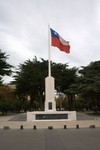
chilean flag on pole
A very big Chilean flag

This afternoon I´ve strolled round more of the city, seen the cemetery with its ostentatious mausoleums, and seen the American antarctic research ship Lawrence M Gould again, tied up at the main jetty.

Tomorrow I´m planning to take the bus to Rio Gallegos in Argentina, and then start making my way north.

Punta Arenas

April 8th, 2007

South America at last! Today has been mostly spent getting from Stanley to Punta Arenas – we took a taxi along the dusty road from Stanley to Mount Pleasant (MPA) – the military base that doubles up as the Falklands´ international airport. MPA is perhaps in the top ten World Worst Airports – the terminal is a mostly featureless steel shed in the middle of the base. Because there´s only one commercial flight a week (due to poor diplomatic relations between Britain and Argentina) there isn´t a proper check-in and all the forms have to be filled in by hand. I managed to fail at every single security check and thus had all my baggage searched, a pat-down body search and a rummage through the pockets of my jacket. Having finally made it to Departures, I was rewarded with a cup of NAAFI tea and a two-hour wait whilst the PA system went mad with spurious and incomprehensible military style announcements.

Once the plane actually showed up everything was straightforward – we left a few minutes early and ninety minutes, another cup of tea and a rather nice little sandwich and pastry later we bounced onto the tarmac at Punta Arenas. Everyone gets off the plane here, goes through immigration and then passengers going on to Santiago get back on the plane again. I claimed my baggage and was met by a friendly chap from a local travel agency who drove me to my hotel. I reckon the time and money spent on Spanish lessons over the winter was worth it once I managed a rudimentary conversation with him during the 20 minute drive into town. I´m staying in a nice hotel (for two nights only – it´s Easter weekend so I booked ahead) and am now going to stroll around the block and find myself some dinner…


Saunders Island

April 5th, 2007

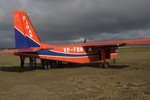
One thing you don’t really appreciate when you’re staying in Stanley is how big the Falkland Islands are – Stanley is quite a compact town, and houses about 3000 residents. The remaining 350 residents live elsewhere, on scattered farms covering an area half the size of Wales. Saunders Island is 30,000 acres, all in the ownership of one family, who live in a settlement of half-a-dozen buildings on one of the few flat pieces of land on the island. We flew there with the Falkland Islands Government Air Service (FIGAS) which is a bit of an experience in itself. You book a flight, saying where you want to go and when, and then you listen to the local radio station at 1815 the night before you fly. The announcer reads the weather and shipping forecasts, and then the flight schedule for the following day. We checked in at 0815 at the little airport outside Stanley (not to be confused with the much bigger international airport and military base at Mount Pleasant). This is not a normal air service – you turn up with your baggage, which is weighed as usual. Then they weigh you as well! Eventually you’re led outside to a Britten-Norman Islander aircraft, which is probably the smallest commercial airliner in service – having just six passenger seats. Our pilot, Derek, showed us to our seats and then off we went. Like all small air operations, weather is a crucial factor and there was fog over most of West Falkland which would obstruct our route, but after some quite exciting low flying (150′!) and then a climb up over a fog bank and down into a hole the other side we landed on the rough grass airstrip at Hill Cove, on the north coast of West Falkland. The plane bounced to a halt, one lady got off, along with various baggage, parcels and mail, and various other freight was loaded on. Then we took off again for a ten minute hop to Carcass Island to pick up Tom and Jade, who’d join us on Saunders.

Islander at Saunders

Finally we landed at Saunders and were met by Suzan Pole-Evans, who owns the island with her husband David. She loaded us into her Land Rover and we made a long and bumpy journey to The Neck, where we stayed in a comfortable portacabin. The Neck is a narrow spit of land connecting the western part of the island to the rest of it – it’s only a few hundred metres wide and is home to Gentoo, Rockhopper, Magellanic and King penguins, plus a whole range of other wildlife – we saw Commerson’s dolphins in the surf, a huge range of small birds, lots of Striated Caracaras (a hawk-like scavenging bird that’s very common in the Falkland Islands – and one which likes to hang around near people), and also a significant number of nesting Black-browed Albatross. It’s a fine place for naturalists, twitchers and photographers!

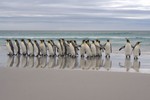
penguins in the surf
Penguins in the surf at sunrise

Far too many wildlife pictures from Saunders Island

We walked, wandered, took lots of photographs and retired to the portacabin to cook our meals and enjoy a glass or two of Chilean wine. A very pleasant few days!

Tomorrow is Good Friday, so everywhere in Stanley will be shut. I’m not quite sure what we’ll be doing – we may go walking again if the weather is good. However on Saturday, I’ll fly to Punta Arenas and begin the great South American adventure!


In Stanley again

March 30th, 2007

It’s quite strange being back in Stanley again – despite only having been here for four days on the way down, the town feels very familiar and there are still a lot of BAS people about so you’re always bumping into people you know. It still feels disconcertingly like the UK – the street furniture and road signs are all UK-style, and the food shops are full of British brands. My first morning in Stanley, however, was spent dealing with the Great British Bureaucracy – I needed a visitors permit stamped into my passport. Dave the Purser on the ship organises immigration – and for most people it was straightforward. However, for the ten of us who were staying in the Falklands as tourists there was a problem – travel insurance. The customs officer needed to see proof that we had insurance to cover medical evacuations in the event that we became seriously ill or injured during the time we weren’t covered by BAS’s insurance. This had been a saga in itself – it’s almost but not quite impossible to buy travel insurance if you haven’t been living in the UK for 12 months and your journey doesn’t begin or end in the UK. After a tip-off from a colleague I bought a policy before leaving Rothera from Travel Nation which doesn’t have those irritating residency requirements. Anyway, three of us trekked up to the Customs office and stood around for twenty minutes whilst a slightly bemused official read our policies and eventually issued us two-week visitor’s permits.

Anyway… yesterday we went to Volunteer Point, which despite being expensive (and boy is everything expensive in the Falklands!) is well worth it. We’d organised two Land Rovers and local guides to take us there, as the journey is quite difficult – firstly you drive for about an hour and a half along the gravel roads to the tiny settlement of Johnson’s Harbour, and then you drive ten miles across rough peaty moorland until you reach the nature reserve. This is a little neck of land with a long sandy beach on one side facing the sea, and a muddy lagoon on the other. On this small piece of land, perhaps half a mile long, there are Magellanic penguins (Jackasses, the locals call them, because they bray like a donkey) in their little burrows, and noisy, smelly colonies of both the small Gentoo penguins and the much larger King penguins. The Kings had chicks, too – small grey ones still huddling around their parents, and much older ones covered in a mass of brown fluffy down.
It’s a magical spot, particularly as the penguins are quite unconcerned at your presence and happily wander around mingling with the scruffy local sheep.

king penguins
King Penguins on the beach at Volunteer Point
Lots of pictures of Stanley and Volunteer Point


Not seasick

March 26th, 2007

As I’m writing this, the Ernest Shackleton’s about 50 miles south of the Falkland Islands and we’re expecting to dock in Stanley tonight. The first part of our trip across the Drake Passage was (relatively) calm and so the ship’s made good speed. Yesterday, however, we had Force 7 winds and huge waves crashing over the bows – making the whole ship shudder and sending a lot of people (crew and Fids alike) to their bunks. It turns out that I don’t get seasick (although I feel a bit dodgy if I’ve been reading a book or sat in front of a computer for more than about half an hour) for which I’m profoundly grateful!


On the Shack

March 23rd, 2007

We sailed from Rothera yesterday morning, waving farewell to the winterers and leaving them to the mercy of the practical jokes we’d played on them! With glorious weather and calm seas we made our way into Margerite Bay, round the southern end of Adelaide Island and out into the Southern Ocean. At this point, the Ernest Shackleton’s legendary hydrodynamics began to produce the chaotic pitching and rolling for which the ship is infamous. Everyone took their Stugeron, and only a few people retired to their cabins. I found I was happier when watching the natual horizon, and headed up onto the Bridge. I found Vicky there already, and as the two of us looked out to the west we saw three whales blow several times in succession a few miles away. You can usually tell a whale’s species from the shape of its spout, and subsequent research revealed that these were most likely to have been the very large but now very rare blue whales – wow!

last view of rothera
Through the porthole – a last view of Rothera

This morning we woke in the calmer waters of the Argentine Islands, where we were to drop of a small team to help sort out some faulty meteorological equipment at the Ukranian base, Vernadsky. This used to be a British base (initially called Argentine Islands but later known as Faraday) and we still have a good working relationship with the cash-strapped Ukranians and tend to bail them out from time to time.
Whilst the ship held her position behind the base, rumours circulated around the crew and Fids as to our intended route. The captain had initially said “no scenic route” – meaning that after leaving Vernadsky we’d go directly to the open sea and set a direct course for the Falklands. In fact, as it was a glorious day and the conditions were calm and largely ice-free, Captain Marshall treated us to a small detour through the utterly spectacular Lemaire Channel before cutting round Anvers Island (passing the American Palmer Station on the way). Lemaire is a narrow channel flanked by high rocky mountains, and in an area with an abundance of wildlife. Stood on the “monkey island” – the upper deck above the bridge – we saw Orcas, penguins and seals in the water, as well as more whales (we think they were humpbacks). Should you ever get the opportunity to take a tourist cruise down the Antarctic Peninsula, make sure it includes this route as it is stunning!

Now we’re back in open waters, with the ship’s motion making you feel like you’re on a slowed-down Waltzer ride at a fairground. We should be in Stanley harbour on Tuesday morning.

Pictures of the journey


We’re history

March 20th, 2007

On Saturday we had a hugely successful fancy dress night with a historical theme. Lots of people dressed up in a variety of intriguing costumes: cave-people, cowboys, Romans, crusaders, hippies and so on. Roger and Pete almost stole the show as Stonehenge (yes, they made a “henge” out of cardboard and danced around in it for a significant amount of the evening) until Kai appeared in a robot outfit made from plumbing spares!
With a certain inevitability, I came as Brunel…


brunel

…with a frock coat made my creative modification of a vicar’s cassock from the dressing-up box and a top hat made from corrugated cardboard and gaffer tape.

On Sunday we had a heavy fall of snow, which makes the base look pretty again.

base in snow


bransfield in snow

This morning the Ernest Shackleton has arrived to take us home. I’ll be moving on board tomorrow night, although the ship will actually leave on Thursday morning.


Shackleton at wharf

This may well be the last post for a while – I’ll try and keep updated whilst I’m on the ship but as the Shackleton is famous for making people seasick then I may be indisposed…


people on point

Final photos in the snow- Lowri, Jade, Tom and (not leaving yet!) Roger


Final furlong

March 11th, 2007

What’s happened since I last wrote? Folk Night – the traditional blend of talent and silliness that forms a kind of end-of-season revue – and the departure of two of the Twin Otters for their winter maintenance in Calgary. We also said farewell to one of pilots, David Leatherdale, who’s retiring after a long period of service with BAS. We said farewell to David in giant orange letters laid out on the apron as he flew past!

We also had a brief visit from Malcolm Wicks, who’s Minister for Science and MP for North Croydon. He came, looked around, gave a *lot* of media interviews over the phone and then went again. He did host quite an interesting Q&A on the value of Antarctic science, although it degenerated into a set of harsh questions and defensive answers on why the previous day his department had announced cuts in the Research Council’s budgets despite these being supposedly “ring-fenced”…

Anyway, we had a final week of flying, mostly in support of the MASIN airborne meterological study, and as part of this I got a morning’s co-pilot down to Fossil Bluff and back. It was mostly clear down King George Sound and I managed to get some nice photos of the ice formations and mountains – Alexander Island and its immediate environs certainly count as one of the finest sights I’ve seen.


crevasse field

Extensive crevassing in King George Sound

Not long after this we had a barbecue over at the Hangar to say farewell to the Air Unit, which somehow became blended with a volleyball tournament! I’m pleased to inform you that the Comms Team (consisting of myself, Crispin, Chris and Mark) made it all the way to the final only to be beaten by Morrison Construction!
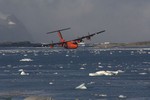
The following morning the remaining two Twin Otters departed, followed by the Dash the following day, although the latter made one more trip to bring us the last air mail from Stanley and finally left for good on Wednesday, doing the by-now-traditional flypast of the Ops Tower (“Negative, Ghostrider, the pattern is full…)


D7 flypast

Dash-7 flypast

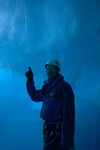
One of the other things about leaving is that you suddenly realise that there are things you meant to do that you never quite got around to. So yesterday I went out with Roger and Alistair and went to explore the crevasse up near Reptile Ridge. It’s quite a strange experience – much more like caving than I was expecting – with chambers interconnected by small slippery passages and occasional shafts of diffuse light coming down through the snow bridges overhead. at one stage we heard a skidoo drive past overhead, which really brings it home to you how important it is to stay inside the safety of the flag lines.


crevasse entrance


roger in crevasse

Inside the crevasse

Next Sunday the Ernest Shackleton will be here and it will soon be over, bar the journey home. I should be back in the UK on or around June 5th, at Portland in Dorset, although this is still subject to change.


Tourists!

February 22nd, 2007

Antarctic tourism is getting to be more and more popular – and that means cruise ships. Further up the Peninsula (at Port Lockroy, for example) they can deal with two or three cruise ship visits a day. Here at Rothera we restrict ourselves to two ships a year, mostly because it’s a huge disruption to the work of the base to spend an afternoon showing tourists around.
Anyway, our first cruise ship of the season cancelled, and so our only visit was from the Hapag-Lloyd ship MS Bremen. The ship arrived on Monday afternoon and tied up at the wharf and I spent a pleasant afternoon showing the 150 passengers around the base. They all seemed to have enjoyed themselves, even though they were only on the base for two hours!


MS Bremen at the wharf

MS Bremen at the wharf


tourists

Tourists on the point
Later in the afternoon I got invited (together with a few colleagues) for dinner on board with the captain. We got a very brief tour of the ship as well. Unlike our ships, where the bridge is on the top of the superstructure and has the best view, on the Bremen the prime space is given over to the Panorama Lounge, which is a huge room with enormous windows giving a forward view. The bridge is immediately below, and is very “traditional” compared with our two ships – it has big meters and gauges everywhere and the minimum of computer wizardry. It is, however, very spacious.

Dinner on the ship was very nice indeed, consisting of about seven miniscule nouvelle cuisine courses – although we were hurried off the ship after our dessert as the captain was keen to leave the wharf before an approaching iceberg got within range.


JCR arriving

February 19th, 2007

Here’s another timelapse video showing the James Clark Ross arriving at Rothera last month – as you can see, bringing the ship alongside the wharf through the brash ice requires some complex manoeuvering!


JCR arriving