The end of the season is nigh

February 19th, 2007

In the fortnight since I last wrote there’s been a definite end-of-term feeling on base. People have completed their field projects and come back to base – some have gone back to the UK already – and the returning Field GAs have evicted the tumbleweed that was blowing down the corridors of the Sledge Store. Our two Royal Navy “air support assistants” have also left – so there’s just three of us now to handle the rapidly diminishing radio work.


elephant seal

This Elephant seal took to living outside Bransfield house for about a week!

Late last night we closed Sky Blu, leaving Fossil Bluff as the only depot open – it’ll close in about ten days’ time.
I’ve taken advantage of a slightly lighter workload to go out on a couple of weekend jollies (I’ve not had much time off at weekends this season so far) – heading out on an afternoon boat trip to Lagoon Island and also reviving my somewhat rusty skiing technique at Vals.
speeding to Lagoon
Speeding to Lagoon


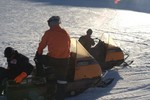
skidoos at Vals

Skidoos at Vals – needed to pull you up the slope


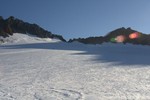
the slope at Vals

The slope itself

In exactly a month from now a ship will be here to take me home. My arrangements have changed somewhat from what I’ve been planning for most of the winter – the RRS Ernest Shackleton will sail from Rothera on the 20th March and arrive in Stanley (in the Falklands) on the 25th or 26th. I’ll be spending two weeks in the Falklands – the first on the main island and the second on the much smaller outlying Saunders Island – before flying to Punta Arenas on Easter Saturday, 7th April. From Punta I’ll make my way north through Chile and Argentina before meeting up with the RRS James Clark Ross in Montevideo on the 8th May. Four of us from Rothera are sailing back to the UK from Monte – we should dock at an as-yet-undecided UK port on the 31st May.


Mike in monster blog update shocker

January 27th, 2007

British Rail would like to apologise for the delay in updates to this blog. It’s nearly a month since I last wrote and so this is a monster catch-up on everything that’s happened so far this year…

Christmas on base was pleasantly low-key, as it’s right in the middle of our busy season. As the weather was good and work was behind schedule we carried on flying, so I spent Christmas afternoon doing air traffic rather than dozing in front of the Queen’s Speech.


A busy day at Sky Blu – three Twin Otters at once!
Shortly after Christmas I got sent into the field. As usual, I was told that I “might possibly be going to Fossil Bluff tomorrow” and then found myself copiloting down to Sky Blu, overnighting there, and then going on the following day to Pine Island, which sounds like a lovely place but is in fact a vast expanse of flat white empty glacier to the south-west of the Ellsworth Mountains. The flight down there does, however, take you right over the mountains (and as these are the highest on the continent, you fly as high as possible and through a handy pass between the bigger ones). The view is awesome, but with so sense of scale it’s hard to judge the size of the mountains themselves. Pine Island Depot is (or was – more on that story later) a typical BAS fuel dump – a hundred or so drums of aviation fuel buried in soft snow in the middle of the wilderness. The depot is marked by an empty drum on the end of a tall wooden pole – this can be seen clearly from the air and will also show up on the aircraft radar.


Flying over the Ellsworths
Our task was to dig up all the drums and fly them out to other depots nearby to be used on forthcoming projects. Over the two years since the depot had last been visited the snowfall had buried the drums under 2.5m of snow, so eight of us armed with shovels dug into the depot and then started dragging the drums out with a skidoo. Having brought 30 or so drums to the surface we split up – a pilot and co pilot going with each of the two aircraft to fly the drums, seven at a time, up to Castle Depot, which was about a 2.5 hour round trip. I ended up doing more flying than digging, as one of the team doesn’t like flying and would rather dig…


Pulling the last drum out of Pine Island depot – it was a BIG hole!
The whole operation took just over a day – we arrived one afternoon and had finished by mid-afternoon on New Year’s Eve. Unfortunately we were just too far away to get back to Rothera for the big party, but Dickie, Geoff, Nico and I welcomed the New Year at Sky Blu with Liz and Mark, who very hospitably shared their food and drink with us.
After that I got dropped off at Fossil Bluff and spent a very pleasant four days in the very homely hut there. It really is an idyllic place to stay – I’d have liked to stay longer but I was wanted back on base again. So ends my Last Field Trip.
Meanwhile, back at the ranch, we’re into the Peak Season. Last year this felt a bit like running a rather chilly branch of Butlin’s with lots of visiting people coming and going for about four weeks, but this season all the visitors came at once, leading to one very disrupted but entertaining week.
It started with ITN, who sent two journalists and two techies down to Rothera to do a series of live reports into the news programmes on ITV1. They seemed to get on pretty well with everyone, but the reporting seemed quite superficial and sensationalised – but that’s the media for you.
Then the whole world went mad. HMS Endurance arrived, and the base was suddenly full of people in incongruous green camoflage. It was certainly very entertaining watching the crew and Marines skiing, sledging and generally mucking around in the snow.
Very shortly after the Endurance we had a late Dash-7 flight from Punta Arenas, bringing us HRH Princess Anne, her husband Admiral Tim Lawrence, and a small entourage. They got off the plane and boarded the ship after midnight with no noise or ceremony. After that, everyone was on their best behaviour!
The plane was actually earlier than planned, but bad weather was forecast and this would be the only opportunity for several days to actually get a flight in. The programme for the visit was hastily rejigged and suddenly we found ourselves giving the VVIPs (yes, royalty get to be very, very important people!) a tour of the field operations departments – including a visit to the hangar to see the aircraft and a look at the work in the Ops Tower. The whole tour was conducted with the absolute minimum of formalities and it was quite clear that the Princess and her party were keen and interested to see everything and meet everybody. Afterwards, a group of winterers (including myself) joined the party for tea and cake and a long and rather rambling conversation that was ostensibly about wintering but went onto a whole range of topics.
On subsequent days they saw pretty much every aspect of the base – the biology labs, the diving facilities, all the physical science work, the water-treatment and sewage works, the whole lot. They also went up to Vals and saw camping and field equipment and rode skidoos! There was also a Winter Olympics in which several teams from the Navy and Marines competed against two BAS teams in skiing, snowboarding, snowball throwing, sledging and snow sculpture. The result was a draw between BAS and the Marines! More practice needed perhaps – in previous years we’ve beaten them hands down…
We also had a ceremony to bury a time-capsule under the new building – a photo of the 2006 winterers and a journal in which lots of people wrote entries will be preserved there (hopefully) until 2107!
There were also two social events – a buffet lunch at which all the VVIPs (the Princess, Admiral Lawrence, Phillipa Foster-Back of the UK Antarctic Heritage Trust and Jane Rumble, who’s head of the Polar Regions Unit at the Foreign & Commonwealth Office and also acts as the “Governor” of the British Antarctic Territory) met all the staff on base in a fairly informal manner. There was also a more formal dinner. A few winterers were picked to sit on the top two tables and to my surprise I ended up being placed next to Princess Anne! The dinner was excellent (thanks to Cyril, Riet and Alan) and everyone seemed to enjoy themselves. The conversation flowed very well on all sorts of topics and then at the end there were a few short speeches – one from Chris Rapley (director of BAS), one from the Princess and one from Jane Rumble, who said that the Placenames Committee had decided to name the mountains on the southern part of Adelaide Island “The Princess Royal Range” in honour of the occasion.
Whilst it was slightly incongruous to see the Princess in BAS-issue moleskin trousers and rigger boots (although to be perfectly honest her private secretary looked much more uncomfortable than she did!) it was clear that both she and her husband enjoyed themselves, relaxed and had a genuine interest in the life and work of the base.
They left on HMS Endurance after four days on base and visited several other bases on the peninsula, including Palmer, Vernadsky and two abandoned British bases, Stonington and Deception Island. The media left a day or two later, although not before I’d had a chance to go over and watch them do a live link into the evening news. This was quite strange for me as it brought back memories of both working at the BBC and (perhaps more) days of doing student TV in York – operating in makeshift facilities using miles of wire and not enough staff!
Now we’re back into the usual routine, although last night the Scottish contingent on base organised a Burns Supper and Ceilidh (I’m still stiff from the dancing) and tomorrow the L M Gould will be back here tomorrow for the traditional party – it should be a good night!


Co-pilot to Fossil Bluff

December 27th, 2006

One of the nicer perks of working down South is going co-piloting. Because the Twin Otter only requires one pilot but BAS regulations say that no-one goes off base alone, sometimes you get asked to go out on a flight. This is a great deal of fun – you get to sit in the front of the plane, enjoy the scenery and help out the pilot with various jobs (usually loading and unloading).
Anyway, a week or two back I got a co-pilot on a routine fuel run to Fossil Bluff and back. This takes about four hours, and begins with making tea and sandwiches to take with you in the canteen whilst the pilots are being briefed on the weather situation. Having got a decision to go from Nico, my pilot for the day, I put my outdoor gear on and headed down to the apron where the plane was being fuelled and loaded.


Clem and Doug fuelling the plane

The plane’s fuel tanks are filled with fuel from the bulk storage at Rothera, but our job today was to take five drums of fuel (just over 1000 litres) down to Fossil Bluff for other aircraft to use when they’re working further south. Loading a plane is quite tricky – you have to be careful to ensure that your load doesn’t disturb the plane’s balance – and the pilot is responsible for arranging the load and lashing everything down with ratchet straps.


Loading drums

Having got the plane fuelled and loaded I was briefed on what to do in an emergency (basically, switch the engines off and get out via any available exit that doesn’t lead to a whirling propeller!)
and then it was time to go. Chocks away and off we go down the runway. The Twin Otters have an extremely low take-off speed (slightly more than 60mph!) which means that even fully laden you can get off the ground using only half our 900m runway.
It was a cloudy day, so we bimbled our way down to the Bluff below the clouds, travelling at less than 1000 feet for most of the journey. With a heavy aircraft it’s important to stay out of low cloud as it can cover the aircraft in a thick layer of ice which makes it much heavier and harder to control. Normally we would have climbed up above the cloud but todays cloud extended from about 1000 to around 12000 feet, so we couldn’t easily climb above it.


Twin Otter console


Nico the pilot

When we landed at Fossil Bluff Nico rolled the fuel drums out of the plane and I helped Mark and Richard to stand them up and arrange them neatly into a depot for use by other aircraft later in the season or next year. Then we loaded the plane up with empty drums and other rubbish to fly back to Rothera.


Rolling the drums out of the plane


Richard and Mark building the depot

After an hour on the ground we headed back. With a much lighter aircraft Nico tried to climb up above the cloud – we went up to 12000 feet (where the air is very thin and you can get a bit dozy) but the cloud was still there for the first part of the journey when suddenly we burst out of it and flew along in sunshine above the cloud tops. Finally we spotted a hole in the cloud and dropped down steeply towards Rothera, and made our approach from the South, passing very close to the James Clark Ross which was moored near the end of the runway.


Home again – Rothera runway and the JCR


Super-hectic

December 27th, 2006

As some of you might have gathered from the fact that I haven’t done any blog updates for six weeks, I have been more than a little busy! In fact I’d go as far as to say that I don’t think I’ve ever worked as hard as I have these last six weeks – starting early, finishing late and fielding constant questions and issues from people during every meal break!

Rather than try and give a full history of what has actually happened, here are the main developments in a few specific areas:

Firstly, the planes. There’s been a lot of problems with the aircraft even after they arrived. We had regulatory issues with the Twin Otters and a huge saga with the propellors on the Dash. In the latter case the Dash and its crew were stranded in Stanley for about a fortnight after turning back in mid-flight with oil pouring from two of the propellors. Eventually parts were obtained and the props were repaired, but it took a long time. Various people who had been given seats on Dash flighs were instead put on the James Clark Ross for a slow cruise down the Peninsula!
Finally in mid-December the BAS board lost patience with the new aircraft maintenance company and revoked their contract, awarding a new contract to the Canadian firm who had maintained the aircraft for the last five years.

Ships: Just before Christmas the James Clark Ross made an appearance, festooned with huge amounts of deck cargo and tied up against the wharf to get rid of it all before heading off round Ryder Bay on a science cruise. When they returned they unloaded everything else and so the base is now a sea of boxes, containers and vast amounts of packaging. There’s always a delicate balance to strike between overpackaging and having stuff damaged in transit, so we end up shipping a lot of packaging material back to the UK for reuse each year.

People: We’re now up to 95 on base, with a large contingent from Morrison Construction who are building the first phase of the new base. More importantly for me we’re now up to full strength in the Comms team. Tristan (my replacement) and Crispin (one of the summer radio operators – he’s an FGA who fancied a change of scene) arrived on the second Dash flight and it’s been a bit of a baptism of fire as we went quickly into a very complex operation to put a team of four onto Pine Island Glacier which is out on the far western edge of our normal operating area. Because of the trouble with the Dash, our two Royal Navy staff arrived on the JCR. Simon and Jamie are trainee helicopter pilots and will be dividing their time between doing comms work and helping out the Air Unit with refuelling, loading and maintaining the aircraft.

Christmas: Everyone always asks about Christmas down here. It’s a lot more low-key than in the UK because it’s right at our busiest time of year. There’s no pre-Christmas build-up and the general consensus is that we don’t think about it until the JCR leaves (usually around the 22nd). But we do now have decorations up, we had our Christmas dinner (turkey, of course, but no bones – bone-in meat is forbidden under the treaty) and people received gifts from home. But today (Boxing Day) all the BAS staff are back at work. I worked on Christmas afternoon – as the pilots wanted to continue flying as we had good weather – but it wasn’t too much hardship!


An inspector calls

November 21st, 2006

It’s now Monday night and we’ve had quite a busy 48 hours! Yesterday three of the Twin Otters flew in and managed to arrive just as the Laurence M Gould was tying up. The sea ice unfortunately prevented the LMG from getting right up close to the wharf – they used a crane and basket to lift people across the gap – and Steve and Tim went on board to introduce themselves and give the usual safety briefing. Because the ship got in later than they’d intended (it was nearly 7pm by the time they were done) the inspectors elected not to start work until the following day. Unfortunately the chief inspector didn’t grant any shore leave that evening, so all the ship’s crew were a bit cheesed off that they were within spitting distance of Rothera Bar but not allowed off the ship for a drink. We were a bit disappointed too – visitors are always a welcome diversion!

Anyway, this morning the air mechanics got on with the task of putting the Dash-7 back together, with the intention of flying up to Punta Arenas in the afternoon. Unfortunately it took longer than they expected so the flight was cancelled – it’ll go tomorrow instead. This gave me a quiet if rather uncertain morning, and so I showed several of the crew of the LMG round part of the base and was then invited back to the ship for a tour, which was very interesting! The Gould is relatively young compared to our two ships (she was built in 1997, whereas the JCR was launched in 1990) but she’s quite different – the bridge and living accomodation feels a lot smaller than on either the JCR or the Ernest Shackleton, but there’s a lot more scientific lab space and facilities. Conversely, as the Gould visits Palmer Station for a resupply every few months, there’s only a very small cargo hold under the aft deck (space for four containers) whereas our ships carry a lot more.

The inspectors saw all that they wanted and were apparently pretty satisfied with our methods, so that’s a weight off a lot of people’s minds!

As for the other ship, the Khlebnikov, she called in on Sunday to say that they had an infectious disease breaking out on board (not dangerous, just unpleasant for all concerned) and so they wouldn’t come and visit after all.

Tomorrow the Dash is going to try and get up to Punta Arenas to pick up a whole load of people – including half-a-dozen builders, the new doctor, and Tristan, who’s my replacement. The Twin Otters will be out doing “circuits and bumps” – landing and taking off again – so that the pilots get a feel for landing on skis again. It shouldn’t be long before we’re getting Fossil Bluff opened up and the season will begin in earnest.


Propeller problems

November 18th, 2006

Well, the Dash-7 did fly in on Tuesday and we did get our mail, which was well worth the wait. Unfortunately, when they came to fly back to Stanley the following day the pilots found that there was a mechanical problem with the Dash’s propellers, all four of them. With only enough parts to mend one of them, the plane’s been grounded. The four Twin Otters have been in Stanley having their skis fitted, and one of them’s gone to Punta Arenas this afternoon to pick up the spare parts. We’re expecting two Otters tomorrow from Stanley and another from Punta on Sunday or Monday. Hopefully the Dash will be in flying condition by Tuesday. To complicate things further, one of the pilots has a lung infection and is unable to fly, so the fourth Otter will have to stay in Stanley until another pilot can go and collect it.

Just as all this drama was unravelling, the Inmarsat phone rang in my office. It was the Lawrence M Gould, the US research ship. They’ve got Antarctic Treaty inspectors on board and they want to make a visit to Rothera. On Sunday. So there’s been lots of running around to sort out all the relevant paperwork and look in the last inspection report to see what we were supposed to have done. The Treaty inspections are mostly concerned with environmental matters – waste disposal and management of environmental incidents (like oil spills) – so it shouldn’t be too onerous. It may, of course, not actually happen, as the Gould may not be able to get here through the sea ice – like most modern research ships it’s “ice strengthened” rather than being an icebreaker.

Our final diversion is another ship – the Kapitan Khlebnikov, which will be bringing us 100-odd tourists to look round the station on Monday or Tuesday. There’s no doubt of the Khlebnikov’s ability to get in here as it’s the world’s largest non-nuclear icebreaker, built for use in the Russian Arctic. When it gets here we may only have 30-odd people on base, so it’ll be all available hands to show the tourists all the scientific work we do and how the base lives, before they all hit the Post Office and clear us out of stamps and teeshirts!


Planes today?

November 14th, 2006

Well, three out of the five BAS aircraft are in Stanley today (two of the Twin Otters are still flying down through Brazil at the moment) and there’s talk of the Dash-7 coming to Rothera this afternoon. The weather’s a bit marginal so we’re making hourly phonecalls to the Falklands to update the pilots as it develops. They’ll decide at some point this morning whether to come or not. The two Twin Otters are having their skis fitted and may or may not be with us tomorrow.
Apparently there’s 120kg or so of post that’s built up in the Stanley office, so there are a lot of people hoping that the mailbags will be here today!


Field work begins

November 7th, 2006

I should also add that on Friday our first field party of the season were flown onto King George Island by HMS Endurance’s helicopters. They’re undertaking a series of geological studies to try and determine past variations in the island’s climate. KGI has the highest density of bases of any region on the continent, playing host to around 10 bases operated by different countries. At present part of our team are staying at the Chinese base, Great Wall, whilst a roving party have spent the last night with the Argentinians at Jubany before being helicoptered to another location tomorrow.
I’m talking to the scientists every evening by Iridium phone, as the radio (which was hastily found in Cambridge when it became clear that we were not going to be able to supply kit from Rothera in time) has failed to work.


Busy week

November 7th, 2006

I like to take life one day at a time, but recently several days have attacked me at once…

It began last Sunday (29th Oct) when we had four Twin Otters fly in from Punta Arenas. All four work for Kenn Borek Air, who are a Canadian firm who operate aircraft on behalf of several national Antarctic programmess. In this case we had one plane working for the US, one working for the Italians and two working for Antarctic Logistics & Expeditions, who run an adventure tourism business from a summer-only base camp at Patriot Hills, on the edge of the Ellsworth Mountains. In addition to 12 Kenn Borek aircrew we also met Di and Chris who were ALE’s “advance party” that would open up Patriot Hills ready for the rest of the team to arrive on the mighty Ilyushin-76 aircraft they charter from the Russians.

Anyway, the following days produced a lot of aircraft-related running around. Kenn Borek operate all their Twin Otters on fixed skis during the season, which means that they have to change from wheels to skis here at Rothera. The fixed skis weigh less than the wheel skis that we use on our aircraft, allowing them to carry a higher payload. Anyway, the two ALE planes had flown in with wheel skis on, landed at the skiway (which is a big flat area of glacier about three miles from base, marked with a 2.5km long line of oil drums) and started to change over to fixed skis. The other two landed on wheels on the runway at Rothera.
Monday saw a good deal of ski-related faffery, as the two sets of wheel skis taken off the ALE planes then had to be dragged down to the hangar behind the Sno-Cat and then fitted to the other two planes. These then flew up to the skiway, landed on the wheel skis and then took them off again in order to fit fixed skis. Unsurprisingly, this took all day!
On Tuesday we had a tricky development – Jim, the pilot working for the Americans, got a phone call asking him to go back to Punta Arenas and collect some spare parts for Kenn Borek’s Basler BT-67 (which we’d seen the week before). This was just at the point at which he’d got his aircraft converted to fixed skis! Fortunately for him, a heavy dump of snow had fallen on Monday night, allowing him to land on skis on the snow-covered runway before going back to wheels again. So Jim flew back to Punta whilst the team working for the Italians flew down to McMurdo – they didn’t leave Rothera until 21:30 and I finally handed them off to McMurdo at 01:30, which made for a late night.
Wednesday was another long day. Jim flew in from Punta Arenas and arrived at lunchtime, changed over to skis (the runway still had just enough snow on it) and then flew out to McMurdo.
Two down, two to go. The ALE planes left on Thursday afternoon and failed to get into Patriot Hills due to low cloud – they diverted to a place called Hercules Inlet and went in to land. After the first plane landed, the pilot of the second plane was unable to contact him by any means, and eventually landed at another location and rang Kenn Borek in Calgary to find out if the other plane’s tracking device was still working. It was, so the plane was still either flying or taxiing. About a day of occasional muddled phonecalls ensued until we rang ALE’s office in Punta Arenas and found that they’d heard from the other plane and all was well.

On Friday Tim declared a day off (as everyone had worked on Sunday getting ready for the planes) and, unusually, we got some decent weather and went skiing. The snow conditions on the Ramp (the steep glacier close to base) were good, and when we later headed up to the main ski area, Vals, it was covered in soft powdery snow, which was great.
On Saturday, feeling a little stiff from the day before, Tim encouraged Ags, Jade and I out for a day’s ski instruction. I can now do something more closely approximating a parallel turn although I think I’ve still got a long way to go…
On Sunday the weather was rather less pleasant and so most people stayed indoors. In my case this was enforced by the fact that in spending all day outside skiing I’d managed to chill my back (the day had started warm and got colder, and I hadn’t been wearing a fleece between my baselayer and my jacket) and it stiffened up. I spent a very pleasant afternoon sitting in the library in a supportive chair reading “The Shadow of the Wind” – a complex and gripping adventure/romance/detective story set in Barcelona in the ’50s.

Today, Monday, we’ve learned that the planes are coming! – the final clearances for the Twin Otters arrived in Cambridge on Friday and two of the Twotters have already left Oxford to make the long journey down. They’ve flown to Porto initially, and will then make their way down through the Canaries and Azores to Fernando de Noronha, a small island off the coast of Brazil. From there it’s on to Rio, Montevideo and finally Stanley. We expect to see them on Monday (13th). The other two Otters and the Dash-7 were fogbound in Oxford this morning but should leave tomorrow. But a lot could happen between now and when they finally get here!


Delays

October 20th, 2006

Oh, and I should have added to my previous posting that our own aircraft are being held back in the UK by various technical and regulatory issues, so we’re not expecting them to arrive before November 9th at the very earliest. This obviously impacts on summer fieldwork, so a lot of people are concerned that their projects might get shortened or cancelled. No BAS planes also means no mail, so Pauline in the office in Stanley will have to put up with our heaps of mailbags for another few weeks.