Radio Spanish

May 18th, 2006

I’m sorry I’ve not written for a while, but I’ve been embroiled in the wonderful world of the “indent”, which is the process of taking stock of all the equipment and supplies I have and deciding what to try and order for next season. I should have it done by the end of the week, and then my colleagues in Cambridge will order all the gear and get it shipped down to us on the James Clark Ross, which should arrive in December.
Since I last wrote it’s got considerably darker (it now gets light at about 11am and dark at about 4pm) and people are finding new things to fill their long dark evenings with. It’s traditional to exchange presents, secret-Santa-style, at midwinter, so a lot of people are spending time in the chippy shop, furtively trying to conceal what they’re making from everyone else! I’m going to start mine tomorrow…
There’s a whole bunch of us trying to learn to speak Spanish, too – lots of people want to go home via South America, so learning the language is a distinct advantage. We’re mostly using a BBC schools book-and-CD combination, although this is aimed at teenagers in school, really, and feels a bit remote from our present situation.
That is, of course, until we get a radio call last week from our nearest neighbours. San Martin is an Argentinian base about 50 miles away on the other side of Margerite Bay. They’re just in range of our VHF repeater, so they’re easy to talk to by radio. So far we’ve spoken to them three times (they’re very keen!) and learned that there are 21 of them, as there are of us. We’ve “met” three of them on the radio – Alexandro the doctor, Victor the communications officer and Abram the nurse. The whole team there consist of men serving with the Argentinian army – so they’re quite keen to speak to the ladies of Rothera!

My Spanish has gone from non-existant to basic, but we’re all a lot keener to learn now that we have some people to talk to. Mind you, I’ve had to compile (by extracting words from Argentinian and Chilean websites) a list of Antarctic Spanish words, as they tend not to feature in the traditional textbooks!

Next week (starting on Saturday) I’m on night watch duty, so I’ll have plenty of time to cram up then. I’ll let you know how it goes!


To Carvajal and back

April 14th, 2006

So, the six of us went to Carvajal, in glorious weather! A week’s sustained good weather is unusual anywhere, but down here it’s especially valued.

The six of us consisted of three trippers (myself, Mark and Jade) and three field assistants (Soup, Bruce and Tom), and we travelled and camped in three pairs. The system for travel and camping has been worked out by BAS over the years, and involves a lot of equipment, which is carried on two wooden Nansen sledges, towed by skidoos. The FGA rides the lead skidoo, towing the “half-unit” sledge, which contains just emergency survival gear. The half-unit is then linked by a 30m rope to the second ‘doo, which in turn tows the “full-unit” sledge which has all the equipment for day-to-day camping on it. The idea is that if you need to do a day trip from your campsite you can leave the full-unit behind and just take the half-unit, which is enough to survive with if you got caught in bad weather. Riding the rear skidoo is quite tricky, as you have to keep the long link-line taught enough that you don’t run over it, but slack enough that you don’t drag behind the lead skidoo. Needless to say, this takes a bit of practice!

Skidoos and sledges
Two skidoos and two sledges – the lead doo is the one nearer the camera. Note the long link-line attached to the front of the second doo

Full-unit and half-unit sledges
Sledges: the half-unit is nearer the camera.

Anyway, we left Rothera on an overcast day, using both skidoos to tow the heavily laden full-unit up to the caboose, where we dug out the half-unit (it had become buried in snow – this happens a lot) and set up for the journey ahead. We drove on for about an hour to Trident, the mountain that marks the approach to McCallum’s Pass – the access to the rest of the island. McCallum’s is the point where winter trips tend to come unstuck – the pass itself and the Shambles Glacier beyond it are prone to crevassing, so you only travel through that area on bright clear days when you have what we call good contrast – you can see features in the snow easily. We had very poor contrast, so we encamped for the night and then set off for a gentle stroll up a small nunatak on the end of Trident. This gentle stroll turned out to be slightly harder than I’d expected, but mostly because I’d made two schoolboy errors. Firstly, I was wearing too many clothes and got hot and sweaty and had to stop and take off a layer, and secondly I failed to check my rucksack properly and only later realised that I’d dragged 30m of heavy climbing rope up the nunatak unnecessarily!

Camping in the Antarctic is done in Pyramid tents, which are very wind-resistant. They’re quite spacious and comfortable inside for two people. You cook inside on a Primus stove, and have a paraffin “Tilley” lamp that provides light and heat. To keep you warm whilst you sleep, you have the BAS Sleeping System (more commonly known as the P-Bag – the prefix P is mostly used in BAS-speak to denote Personal) which consists of:

– a sleeping board that goes on top of the tent groundsheet
– a foam camping mat (“Karrimat” style)
– an inflatable camping mat (“Therm-a-Rest”)
– a sheepskin rug
– a polar-grade down sleeping bag, in a canvas cover to protect it from grease and fire.

Sleeping board
Sleeping mats
Sleeping bag

You can also put a fleece liner in the sleeping bag to make it even warmer, although I’ve never met anyone who’s done this, as the bags are pretty warm as it is. I use my fleece liner as a pillow. Everything except the board rolls up inside a giant plastic-lined stuff-sack (the P-bag) which is carried on the full-unit sledge.

Anyhow, Day 2 dawned bright and clear, so we packed up (this takes 2 hours!) and drove up over McCallum’s and down onto the Shambles Glacier. Here we switched to double-heading to drag the heavy sledges up onto the plateau – towing one sledge with two doos, then going back for the other one. Finally we reached the plateau and sat in the sunshine eating chocolate and Biscuits Brown (military style hard savoury biscuits) before heading on down to Carvajal. We made good progress and got to within a mile of the base by about 5pm. However, the worst was yet to come – the section of glacier that goes down to the base is prone to crevassing. Tom and Kirk had come in at the end of February (by air) and skiied down the glacier putting in a flagged safe route. When we arrived, we found that most of the flags had been blown away, and as we negotiated the glacier, one of Tom’s sledges hit a mini-crevasse and turned over. In the end, Tom, Bruce and Soup roped up and went down the glacier to probe for crevasses, whilst the rest of us stood around and admired the view.
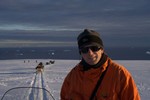
Waiting...
Waiting…

We finally arrived at the base just as it was going dark, to find it uninviting and slightly forbidding – the area is colonised by noisy, smelly and agressive fur seals, and the base itself is shabby, cold and damp. Jade said that it felt like one of those Scooby-Doo adventures!
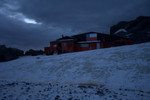
Carvajal in the half-light
Carvajal looking forbidding in the half-light

Inside, Carvajal feels like a lot of church hall’s I’ve visited – faded 1960s/70s decor, a large but tatty commercial kitchen, paint peeling from walls in some rooms and a general air of neglect. It began life as a British base, Adelaide (base T), and was Rothera’s predecessor. In 1976 the British abandoned the station in favour of Rothera, as the ski-way for aircraft was becoming badly crevassed. There’s still a wrecked BAS Single Otter aircraft there to this day.
The Chileans took over in 1981, and used it as a summer-only station in the 80s and 90s. They last used it in 2003, and prior to that only visited it every couple of years. I suspect that they’re unlikely to return to it, but they’re equally unlikely to admit that it’s abandoned, as under the Antarctic Treaty they would then be obliged to remove it!


Dining room at Carvajal
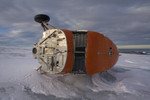

Remains of a Single Otter

Anyway, we made ourselves comfortable inside, and with Tilley lamps going we were able to make the little lounge quite cozy. We had planned to leave the following afternoon, but after waking up late we decided to stay an extra night and spend the day looking around the base.

Looking over Carvajal
Looking out over the base from the hilltop

Candlelit dinner for six
Candlelit dinner for six – wearing all our warm clothing!

The following day we packed up and drove back north to The Myth, a large mountain about halfway between Carvajal and Rothera. We camped nearby and then spent the following day mountaineering. Soup and I considered climbing The Myth, which is a similar height to Ben Nevis, although that’s measured above sea level and we were already quite high up it. However, on closer inspection the ridges looked very exposed, particularly for a beginner like me, and so we chose to climb the smaller Point 762 instead. At 762m above sea level, this is the runt of the litter of mountains surrounding The Myth, but we had an enjoyable day out and drank tea on the summit before abseiling and climbing back down again.
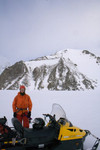
Me in front of Point 762

On the final day we knew the weather was likely to deteriorate, so it was full speed ahead to reach McCallum’s whilst we still had some contrast. We arrived back at Rothera at around 4 in the afternoon, tired and happy!

Here are the rest of my pictures of the trip.


Winter holiday

April 5th, 2006

Well, the Shackleton finally left on Monday morning following a weekend of poor weather that made it difficult to load all our waste into her hold. We all stood on the wharf at 6:30am and waved off our friends and colleagues who are heading back to the Falklands and points north.
We let off some out-of-date distress flares in the half-light, making a memorable scene!
Then we all went back to base for a cup of tea, breakfast and contemplation of being alone in the wilderness.

Saying goodbye on the wharf

Flares at dawn

Then the Germans arrived. This was a brief visit from a small helicopter that operates off the research vessel Polarstern – they came to collect some blood samples and meteorological data that one of our aircraft had retrieved from Neumayer base a few weeks ago. They also went away with four packets of yeast, as they’d run out!

After the helicopter disappeared, we all set-to cleaning the base, which we’ve just finished two days later. Several of us (including me) have also moved rooms in order to be on the nicer side of Admirals House (the side with a view!)

Soup and I have now packed up all our field kit (and there’s a lot of it) onto two Nansen sledges, and we’re heading off in the general direction of Carvajal tomorrow. Let’s off-road!


Supplies, supplies

March 30th, 2006

Since the Ernest Shackleton arrives it’s been all hands on deck to unload the cargo – there’s food and supplies for the winter, building materials for the second season’s construction work on the new building and lots and lots of fuel – for the base itself and for the air operations next season.
We’ve also unloaded the bond – the stocks of alcohol – for the next eight months…


Watching the Shackleton arrive

Watching the Shackleton arrive at dusk

Whilst the ship is in, all the winterers have been to see the dentist, who comes in to each base at last call. My teeth are healthy, although I’ve been reminded about the importance of flossing!
This was a slightly surreal experience, as the light swell at the wharf allows the ship to demonstrate its legendary vomit-inducing roll, even whilst tied up. Having your teeth scaled whilst the chair, surgery and dentist all roll gently from side to side is a bit bizaare, but you get used to it. What’s worse is walking back to the gangway having got used to the ship’s motion and seeing the land heaving up and down. Wierd!


Wildlife on One

March 29th, 2006

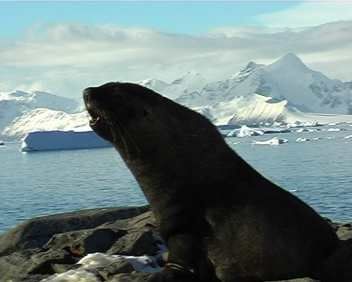
Here’s another video postcard, this time of wildlife on Rothera Point. I don’t think David Attenborough will be looking to his laurels, though!

wildlife


The Shack is here!

March 29th, 2006

The Ernest Shackleton arrived last night at about 7:30, so we’re now into the busy period of cargo handling. I’ll post some pictures soon, but in the mean time I’d like to say thankyou to all the people who sent me letters and parcels which arrived on the ship.

More soon!


Ready for winter?

March 18th, 2006

Now, after the planes left I thought that I’d have more time to update this blog, but I was wrong, wasn’t I? Actually, a lot has happened since I last wrote – we’ve said farewell to the Air Unit, leaving 56 people on base to wait for the RRS Ernest Shackleton and the coming winter.

A quick rewind over the last three weeks: we had Folk Night, which features no folk music, but is a kind of revue/variety show put on by various people. Much silliness ensued. I was mostly behind the sound desk, but I did take part in a unique performance by Rothera’s very own band of Morris Men! This was very well received, and the cause of much hilarity. Here’s a video of the Morris Men in action. Anyway…

After the Dash-7 departed, taking the last of the Air Unit, the base breathed a general sigh of relief. However, there was relatively little peace for the wicked, as those of us wintering have had to add further strings to our bows – we’ve all had training on what to do in case of an oil spill, how to do a nightwatch round, how to use breathing apparatus to search a building in case of a fire and a meeting with Tim, the winter Base Commander, to discuss winter trips, gash, cook duties and other matters relating to the coming winter.


Rothera from the air
Rothera from the air – the base is now snow-covered again

Our winter training trips will begin shortly after the ship leaves – we all get six days off-base in the company of a field assistant to go and travel, climb mountains and generally learn about fieldcraft and have a good time. I’m going with Mark Laidlaw, who I shared a room with until recently, and the plan is to head out to Carvajal (pronounced Car-ver-harl), which is a largely abandoned base about 80km from Rothera. Carvajal began life as a British base (Adelaide, or “Base T”) but was transferred to the Chileans when Rothera was built to replace it in 1976. The Chileans have now largely abandoned it, mostly because the aircraft ski-way has become badly crevassed and it’s too dangerous to land there.

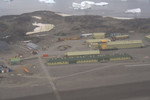
Carvajal from the air

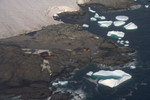
Before the aircraft left, all the winterers went for a “familiarisation flight” on the Dash-7 to see the sights of Adelaide Island and the surrounding area. We have a second round of winter trips in August-September, and on the off-chance that there might be good sea-ice this winter, the plane also showed us Horseshoe Island and Stonington Island (abandoned British bases) and San Martin (our Argentinian neighbours) although the chances of being able to visit any of these is extremely remote. Here are some photos from the flight.

Mountains on Adelaide Island

The weather’s also become much more wintry – the temperature is now staying below zero, and we’ve had about five days of continuous snow, so the yards and buildings at Rothera are now snow-covered again, as they were in November when I first arrived. The fresh snow has been met with delight by the skiiers and snowboarders on base (most of us!) and I spent most of last weekend “up the hill” enjoying the snow. In fact, on Sunday night, Andy, Rob and Riet organised a barbeque at the caboose, so most of the base were up skiing and eating and enjoying the fine weather, fresh snow and distinctly surreal atmosphere!

The Ernest Shackleton should be with us on the 27th, and you can follow her progress on the Sailwx.info tracking map.


Mass exodus

February 25th, 2006

Rothera has a rather end-of-term feeling at the moment. The field parties have returned to Rothera (and some to the UK), Sky Blu has closed up for the winter, and Fossil Bluff should close today or tomorrow. A lot of people have left, or are about to leave, on the Dash-7, and two of the Twin Otters have headed back to the UK (as of this year they get maintained in Oxford rather than Calgary) this morning. They’re going a very circuitous route – from Rothera to Stanley, Montevideo, up through South America, across to Bermuda, St. Johns and and back to the UK via Greenland and Iceland. The rest of the aircraft will follow them next week. The base already feels a lot quieter. Everyone who isn’t wintering or leaving by air will leave on the RRS Ernest Shackleton at then end of March.

In other news, Rothera has a new webcam and I’ve put it and a load of other Antarctic webcams in the links column. You can now see what the weather’s like!

When I was at Fossil Bluff, I made some chutney and posted it back to a friend in London. He pronounced it “tasty”. I thought that I’d share the recipe, if anyone wants to make their own – although you could probably do it with fresh vegetables rather than dried!

I thus present the recipe for Antarctic Chutney:

– dried onions (some)
– dried apple rings (some)
– dried green beans (lots)
– sultanas (a few handfuls)
– filtered glacial meltwater
– 900ml malt vinegar
– Turmeric (couple of teaspoonfuls)
– Black peppercorns
– Coriander seeds (generous shake)

Put the onions and some water into a pan and heat and allow to soften. Add beans, apple rings, sultanas and more water and keep softening. Once all the vegetables are soft and breaking up, add the vinegar and spices and simmer gently for several hours until the mixture will stick to a wooden spoon. Put into jars. Cool. Eat.


Doing the Met at Fossil Bluff

February 16th, 2006

By popular demand, here’s another video postcard: The weather at Fossil Bluff. I hope you enjoy it!

the weather at Fossil Bluff


Anyone want my job next year?

February 14th, 2006

The job ad has appeared to be next year’s Comms Manager: http://www.bas.ac.uk/Employment/vacancies/job.php?id=444