Fossil Bluff and Sky Blu

February 14th, 2006

So, I’m back. And I’ve had a shower. Although I’m so far retaining my Polar Hero Beard, which has reached the two-week stage. Some people like it. Other people laugh. Combined with the fact that I haven’t had a haircut since coming south, I’m now the hairiest person on the Comms team (Pete had his ponytail shaved off for charity whilst I was away!). But anyway, you’ll want to know what I did whilst I was away…

Polar Hero Beard
Two weeks’ growth…

So, I finally went to “the Bluff” on Tuesday 31st Jan, via Latady Island, which is in the South Pacific – though being small, flat and snow covered, it’s not your conventional Rogers-and-Hammerstein vision of that region! We went to collect a small physical science team (Georgina, Cathy, Tom and Andy) who’d been drilling ice cores and retreiving a weather station – the latter was particularly exciting as it had been buried in several metres of snow and necessitating a vast hole to find it.
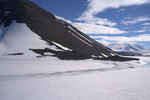
A first view of Fossil Bluff

Anyway, we arrived at Fossil Bluff with a full plane, and myself and the science team were left there – Alan took the plane back to Rothera with a bioscience team who’d been to Coal Nunatak the previous day. So the Fossil Bluff Motel and Diner found itself with a full house for the night!

The hut itself
The hut itself

Fossil Bluff (also known as “the Bluff” and “KG” – short for King George Sound) is BAS’s first and only station on Alexander Island, and was notable in being the only wintering base ever established entirely by air – it’s hundreds of miles from the open sea. It opened in 1961, and became summer only in the mid-70s. The hut and a lot of the fixtures and fittings date back to its early years, and it has a very pleasant and comfortable atmosphere. The hut itself is located at the foot of the huge scree cliffs that give the place its name, although it’s now nearly 1km from the skiway where the aircraft land – the Eros Glacier has retreated, living the hut high and dry on a ridge of moraine. In 1961 aircraft landed outside the front door!
Inside, there are four bunks, a table and chairs, some work surface, a cubby-hole with the radio and weather instruments and a Rayburn stove (perhaps the world’s most Southerly one!). The stove is the heart of the place – it burns the dregs of Avtur (aviation fuel) left in the bottoms of the barrels when the aircraft are refuelled – and is also used for baking bread and general cooking. It’s warm and cosy – Cathy described it as “Little House on the Prairie”, and it certainly feels like it. There’s even running water (on warm days) – a header tank is filled by meltwater coming down the valley behind the hut, and fresh filtered water is piped directly to the kitchen tap.

Rod and Riet in the hut

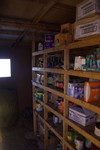
Outside the hut are a cluster of random little buildings. There’s a generator shed, containing a vintage Lister-Petter diesel generator, a food store (known universally as “Tescos” and painted with red, white and blue stripes) and a garage, which contains an ancient Muskeg tractor – a little tracked vehicle which drove to Fossil Bluff over the sea ice from Stonington in the mid-Sixties. There’s also the emergency caboose, which is an Antarctic caravan – it’s a little hut on skis, which has enough room for two people to live in. In days of yore it would be towed behind a Muskeg on long trips, providing accomodation for the team. Now it acts as overflow accommodation and a place to sleep if the hut ever burned down.

Caboose and generator shed
Emergency caboose (blue) and generator shed

Inside the caboose
Inside the caboose – a bit cramped for two!
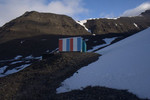
Tescos
Tescos!

Well stocked shelves
Well-stocked shelves inside, although very little is in date!

Muskeg tractor
The Muskeg in the garage

Living at the Bluff is like running a filling station, motel and restaurant for passing aircraft. The day begins at 0700, with the first weather observation, which gets passed to Rothera. You then give hourly observations until the aircraft no longer want them. If a plane comes in, you have to travel down to the skiway on skidoos and meet it. If the plane needs refuelling, you have to dig out the drums of Avtur and test them to check they’re not contaminated with water. Then there’s a little fuel pump (known as a Spate pump) which is powered by petrol and pumps the fuel into the aircraft. Other aircraft come in from Rothera on fuel runs – they land, drop off 4 or 5 drums of fuel onto the depot and then return, taking empty drums, rubbish and other cargo.
Often people get stuck at the Bluff because the weather worsens at their destinations, so they come back to the hut for tea/lunch/dinner/an overnight stay. We had ten of us there for several days, waiting for a weather window on Smyley Island that never came (the team went back to Rothera) and then several days with just three of us – Rod, Riet and I – sitting reading, cooking, digging depots and doing the odd bit of mountaineering close by.
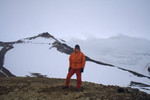
Me on Giza Peak
On Giza Peak (also known as Sphinx, because of its shape)

Eventually our orders came on the radio – Riet and Rod were to return to Rothera, to be replaced by Pat and Richard, and I was going to Sky Blu. Then the weather worsened again. Finally, one afternoon, we got an Iridium phonecall. Someone at Sky Blu was ill – they were sending an aircraft – could we fuel it, and could I take the plane to Sky Blu? So I packed my baggage and took the late night plane – we arrived there at midnight (in broad daylight) and Alan returned to Rothera at 4am!
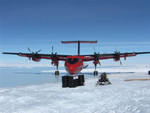
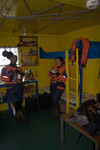
Sky Blu is a completely different kettle of fish. It’s another two hours south of the Bluff, and is “properly Antarctic” – never above freezing, covered in snow, and with a vicious wind that blows up the snow so you can’t see what you’re doing. This same wind scours snow off the surface, so instead of forming a bumpy snow-covered glacier it forms a sheet of perfectly flat and level blue ice. This ice gets covered in a thin layer of snow, but is usable as a runway for wheeled aircraft (including BAS’s Dash-7) as it’s cleared by a snowblower. The facilities are considerably more basic than Fossil Bluff, too: a fibreglass “Melon” hut with a little paraffin heater and a (slightly scary) two-burner petrol stove, plus a Weatherhaven tent (like a farmer’s polytunnel, only better insulated) and a few BAS Pyramid tents. There’s also an underground garage, cut out of the ice with a wooden roof. I spent three days there, two of which were spent largely inside the Melon hut, cheek-by-jowel with everyone else.

The Melon hut
The Melon hut at Sky Blu – on a nice day!

Inside the Melon
Jamie and Georgina inside the Melon hut – it’s cramped with ten inside!
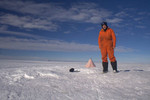
Me at Sky Blu
Orange boilersuits are all the rage in the Antarctic…
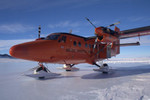
Twin Otter
Twin Otter, on ice

Dash-7 at Sky Blu
Dash-7

On the third day the weather was clear. One plane that had stayed with us for a few days went off to Smyley Island to do more ice-coring, then we had another plane arrive aiming to go and pick up a field party on the Rutford ice stream, then the Dash-7 on a fuel run (a very impressive sight) and then another Otter on a transfer from Halley. This plane picked me up and took me back to Rothera – end of trip!
Arriving back at Rothera the weather is damp and warm and miserable. And dark. I came out of the bar at around 1130 to find it actually properly dark for the first time since I arrived. Winter is coming…

Lots more pictures of the trip – I will try and do some video editing this week, as I have about three video postcards in the pipeline!

Delayed…

January 31st, 2006

Fossil Bluff has been fogged in for the last few mornings, but it looks like I might finally go today… we’ll see!


Laurence M Gould and Fossil Bluff

January 29th, 2006

Yesterday we had a visit from our American friends on board the research ship Laurence M Gould, who tied up at the wharf and came ashore for an evenings entertainment. This is a regular social visit, which happens a) because they’re passing by us anyway and b) because US research vessels are “dry” and they like to come to a British base for a beer!
We put on a good show for them – the final ever Tepid Stan gig in the Sledge Store and a good time was had by all.

This morning I’m supposedly (weather-permitting) off to Fossil Bluff to stay for a week or so. I may be longer than that! If you want to contact me during that time, you’ll need my BAS email address (the one that begins mrpr@south) and be prepared for your message to be read out over the radio! Actually, one of the things I’m doing is working on an experimental system to send email over the radio as a data transmission, so we’ll see how well that works…


Boat trips

January 29th, 2006

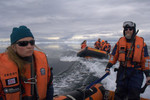
Now that the sea ice has cleared out, the boating season is in full swing: Rothera has five inflatable boats which are mostly used to support diving and marine science, but on Saturday afternoons the boatmen (Andy and Bernard) do pleasure cruises to the Leonie Islands, which are a few km from Rothera.

People in boats
Rosie and Bernard model the Rothera Nautical Collection

I was on one of these last Saturday, and enjoyed myself hugely. You start in the boatshed, and manoeuvre yourself into a big orange survival suit (orange clothing is de rigeur down here, you get used to it!) and then walk down the slipway to the boats. We spent a very pleasant afternoon whizzing around looking at icebergs, penguins, cormorants and other wildlife, and then headed over to Lagoon Island for a cup of tea. Lagoon is named for the shallow lagoon in the centre of the island, which is a popular spot for elephant seals – we saw a large number of juveniles dozing in the summer sun – and has a pleasant little wooden hut which is used for biosciences expeditions and jollies throughout the year.

Elephant seals
Juvenile elephant seals – they grow a long snouty nose in adulthood

Lagoon Island Refuge

Andy and Layla have tea at Lagoon

Fortified by a cup of tea made on the Primus stove, we headed back to Rothera, but stopped to take pictures of a leopard seal lounging on a small berg. Leopard seals are the only really dangerous animal down here – a young biologist, Kirsty Brown, was drowned by one a few years back – and they eat penguins and (sometimes) other seals.

Leopard seal
Leopard seal

In this case, the pictures really are worth a thousand words!


Mega-Meccano

January 18th, 2006

Apologies for the ‘radio silence’ since New Year but, as many of you have guessed, I’ve been very busy indeed. We’ve been a little bit short-handed in the comms team since all three of our radio operators have been away working at Fossil Bluff and Sky Blu, two remote fuel depots that get used to refuel aircraft during the summer season. Actually, only two of them have been away at a time – just after Owen returned from Sky Blu, Mark’s gone out to replace him. This is a rather roundabout way of saying that Andy and I have worked extra shifts on the radio and have had relatively little time off, especially at weekends. Anyway, we’ve also been doing some project work as well as the usual flight following and field party scheds – we’ve been building a Really Big Antenna! This is like a giant TV aerial and is mounted on top of a stumpy little tower on top of Rothera Point – and it can be turned around by an electric motor to direct the signal to distant field parties. The proper name is the RLPA – the Rotatable Log-Periodic Antenna, and we’ve been working on it since just before New Year.

RLPA tower
The tower, before the antenna and gearbox were fitted

We started in the aircraft hangar, putting together a giant Meccano kit made from aluminium with very poor instructions. If you think IKEA instructions are incomprehensible, don’t buy one of these! The boom that supports the antenna elements is 40 feet long (sorry for the imperial units – the antenna is made in the USA so all the dimensions are in feet and inches…)
and is held together with about two hunded nuts and bolts, all of which we did up by hand.
Having built all this, Mat the Mechanic helped us load it onto a flatbed trailer, and we dragged it up the hill to finish the assembly. Attached to the boom are 16 elements, which are tapering aluminium tubes that extend from each side. These are very long and quite whippy. At each point where the aluminium tubes join we had to polish the joint with emery cloth and apply an anti-oxidant grease to make a good electrical connection.

Once the antenna was assembled, the fun part began. We had to move it about twenty metres across an uneven snow surface and then hoist it onto the top of the tower and fasten it to the rotator. After a few ideas were considered, we went for a “people power” approach. Fourteen of BAS’s finest staff lifted the antenna off the trailer and carried it across to the waiting crane. Several tense minutes and a good deal of “left-hand-down-a-bit”, jiggling and brute force later, Andy and I bolted it to the rotator mountings and breathed a sigh of relief!

Carrying the RLPA
People power!

Easy does it
Easy does it…

Up and away
Up and away!

Bolting it on
Bolting it on

Since then we’ve been doing the much more tedious job of cable laying- all sorts of power, data and signal cables have to be fed out to the antenna and its ancillary kit, so we’ve been dragging cables across the frost-shattered rock surface of the point and laboriously attaching them to catenary wires with cable ties. Actually, Andy’s done most of the laborious attaching, and I’ve done most of the laborious ladder-repositioning, tool-passing and cable untangling. We’re now about 60% done on the cables – they just need to go across the yard to the Ops Tower – Pat’s been showing us how to use the “cherry-picker” hydraulic platform today, but it was too windy to do any work with it this afternoon, so that’s a project for tomorrow. Hopefully we’ll have the system all wired up by the end of next week.

Thanks to Agnieszka for her excellent photographs and mast-climbing skills! There are more pictures here.


The festive season

January 7th, 2006

As I write, the Christmas decorations have been taken down and the base has resumed normal life again. Mind you, the place was only lightly touched by the festive hysteria that occurs back home – we’re right in the middle of our busy season, so we can’t afford to take lots of time off! In fact we had Christmas Day and Boxing Day off, plus New Year’s Eve and New Year’s Day. Christmas Day itself dawned under leaden grey skies (just like home!) and a light flurry of snow. After a slow and quiet morning, most of the base went off to the ski slopes and then returned for the full festive dinner at 5pm. I had to work, though – field parties still need a daily radio call – but a lot of people came up to the radio room to wish them a happy Christmas.
New Year provided an ideal opportunity to show off the finely-polished musical talents of the base to the various new arrivals. Two bands, a freshly-formed Summer Band and the veteran winterers Tepid Stan, performed to a packed Sledge Store and received a very warm reception from the assembled crowd. The following day dawned bright and clear with just a few people up and about by lunchtime, although many went out skiing or boating in the afternoon. It was very pleasant, and rather more relaxed than back home!


Comings and goings

December 25th, 2005

A lot has happened since I last wrote – I’ve been very busy indeed and haven’t had a chance to sit down and write. I’d no sooner got the smell of Avtur (aviation fuel) out of my clothes than Andy and Owen, two of my colleagues on the Comms team, were sent down to Sky Blu to man the depot there. This left just three of us (myself plus Mark and Pete) to cover all the flying and field party scheds, so we’ve been working pretty hard.
We’ve had a lot of people come and go through the station in the last fortnight – we started with a team of four pilots from the German antarctic research programme, who arrived from Punta Arenas in their Dornier 228 aircraft. The Dornier is a bit bigger than our Twin Otters, and slightly faster, but it requires a much longer runway. In fact, it needed almost the entire runway before it was airborne, which is distinctly nervewracking! They stayed for one night and then flew on to Halley – from there they transfer to Neumayer, the German base in Dronning Maud Land.
We also had two of our Otters make the long flight to Halley – one went to stay for the duration of their season (until the end of February) and the other returned a few days later, via Berkner Island and Sky Blu, bringing back a few staff who needed to make a quick exit and a whole pile of parcels to be sent back to the UK.
After that, everyone’s mind was on the imminent arrival of the James Clark Ross, bringing food and cargo for the station. It got very close to Rothera but then became stuck in the ice near the southern end of Adelaide Island. I was lucky enough to go out on an Ice Observation flight in the Dash-7: this involved flying a number of low passes over the ship and surrounding sea to try and find breaks in the ice and was very exciting! However, all looked black the following day when it became clear that ship was not making any progress and eventually the captain decided to turn around and look for another route. 24 hours later, though, the ship had slunk through between the areas of hard ice and was steaming across Margerite Bay towards Rothera. Thus began the Relief of Rothera – the process of unloading all the cargo for the coming year. In fact, the JCR was supposed to go out and do a small science cruise in Ryder Bay, but the ice conditions prevented this from going ahead – so we had our full relief a little earlier than anticipated. It really was a case for everyone to muck in and shift the cargo and pack it away. Most days a party of up to 30 Rotherans would be called down to the food bays to stow away all the boxes and tins of food that the ship had brought – human chains of people shifting endless tins of mushrooms will be one of my memories of Rothera!
Around the same time as the ship arrived, the Dash-7 went north to Stanley with a few people whose work was already completed, and took more people out to meet HMS Endurance and prepare for fieldwork on the northern part of the Antarctic Peninsula. It returned in the middle of relief – the base suddenly seemed full of people and the queue for dinner stretched right across the dining room and onto the stairs. Then, just as suddenly as it had arrived, the JCR sailed off into the not-sunset leaving us piles of stuff to sort out. We’ve also welcomed the rest of the new winterers and a few more summer staff to the base – they’re all getting used to life on land again after up to three weeks at sea!


Sky Blu and the Rutford Ice Stream

December 9th, 2005

I’ve been away for a few days – two days, to be precise, although it felt like a lot longer. I’ve accrued a fair number of air miles and seen a lot of interesting places. After several days standing around waiting for aircraft to be workable and the weather to be suitable, we left early on Sunday morning – pilot Doug, myself, and Kat, one of our terrestrial biologists. We headed initially for Mars Oasis, which is 200 or so miles away to the south of Rothera, on Alexander Island. Mars is the site of a number of long-term studies into Antarctic vegetation (mostly moss and lichen) and we flew in under the low cloud and dropped Kat off, collecting her colleague Kevin by way of exchange. A short flight from Mars is Fossil Bluff, where we refuelled the plane and dropped off Kevin to catch a connecting plane back to Rothera. Fossil Bluff is an old wintering station which is now occupied by two staff from Rothera during the summer and is used as a refuelling station for the Twin Otter aircraft. Doug and I then flew south to Sky Blu, another refuelling stop, which is named for its incredible natural runway, formed from a sheet of blue ice. It’s as flat as a skating rink and just as slippery. Astonishingly, we can land our large Dash-7 aircraft here (on wheels – it doesn’t have skis like the Otters) although Doug is quoted as saying that landing the Dash at Sky Blu is “like a one legged man wrestling an alligator on a skating rink”!
It was good to meet up with Bruce, Alex and Roger, who’ve been at Sky Blu for several weeks now, all except Alex sporting beards and smelling strongly of Avtur, the sweet-smelling aviation fuel that they spend a lot of time pumping into aircraft. After a quick cup of tea in the little fibreglass hut they call home, Doug headed out with Hilmar, one of the glaciologists, who’d arrived that morning on another aircraft. They spent the afternoon and evening flying around the Rutford Ice Stream setting up GPS stations to monitor its movement. The Rutford is one of the big ice streams that drains the Antarctic continent of ice and snow – it’s one of the fastest glaciers on the continent and can move up to a metre a day. Consequently it’s of great interest to our beakers, and we have three field parties doing science there this year. I spent the afternoon at Sky Blu helping out with odd jobs and cooking dinner from an assortment of tinned and dried foods over the Primus stove in the hut. Doug returned around midnight, bringing with him Tom, who he’d collected from Hilmar’s camp when he’d dropped Hilmar off – are you following all this? Sky Blu, being 74 degrees south or so, doesn’t even have any semblance of a sunset even at midnight, so it felt very strange going to bed in the hut in full sunlight.
The following day came (it didn’t dawn – the sun hadn’t set) and I headed out again, this time to take Alex and Roger down to the RABID depot. RABID is short for Rutford Area Base of Ice Drilling, and it was a major field camp during the last few years, where ice cores were drilled into the glacier. Now it’s just a vast depot of fuel and scientific gear, and every year some people get sent to dig it out of the snow and make it secure for the following season. We flew down to the Rutford, where the landscape becomes completely flat except for the Ellsworth Mountains, which look like they’ve been whipped up from Christmas cake icing – all white and lumpy – and which include Mount Vinson, the highest in Antarctica. The plane landed, we unloaded all their equipment, checked that the radio worked, and then flew off back to Sky Blu, leaving Alex and Roger to set up camp. After refuelling, it was time to load the plane with some drums of petrol and boxes of food and fly off to another part of the Rutford to put in a depot for one of the field parties who’ll be travelling across the glacier. This was a four hour round trip! Then we went on back to Rothera via Fossil Bluff. By the end of the 48 hours I was stiff, tired, smelled of Avtur and wondering how the pilots do it every day! But it was good fun and I would do it all again…


Sky Blu and the Rutford video

December 9th, 2005

I’ve made a short video of Sky Blu and the Rutford – enjoy it!

Sky Blu and the Rutford


Stormy weather

December 2nd, 2005

A sudden change in the weather has hit Rothera and our surrounding remote stations and field parties – we had 24 hours of high winds with blowing, drifting and falling snow, which is giving the base an altogether more wintry look. A lot of the snowdrifts that had been cleared away have now started to reform, but the biggest change is that the sea ice has started to break up and a lot of it has blown away from the base. This is good news for us, as it means that we will soon be able to launch boats and start the marine science season in earnest. It also means that the James Clark Ross, which is making its way towards us with its precious cargo of new equipment, food and beer, not to mention a whole load of summer and winter staff, should have no difficulty in getting into the base when it arrives in about two weeks’ time. You can follow the JCR as it makes its journey from Stanley down to Rothera.

Before the weather changed we managed to get some concreting done. We’re erecting a new mast for communication with remote field parties, and so we took advantage of a few sunny days to get the foundations put in. Now, my only previous experience of laying concrete was putting down a foundation for a greenhouse in my parents’ garden, and it was incredibly hard work and involved moving what seemed like tonnes of stuff in a small wheelbarrow. Here we were laying a lot more, and doing so on top of a rocky peninsula in the Antarctic. The job began with Andy and Pat drilling holes in the rock with a pneumatic drill – these took steel reinforcing bars that would strengthen the concrete. This was very hard work and involved much cursing when the drill became trapped in the rock by dust and shrapnel. Glen the Carpenter built and fittted the wooden shuttering to shape the concrete and then we were ready to mix and pour. Favours were called in, and on a bright sunny morning I turned up on site to find that concreting was already in full swing (I’d had some indoor duties to do immediately after breakfast) – but every labour-saving device was employed to make it a much easier job than at home! Firstly, an industrial concrete-mixer has a hydraulic scoop for the aggregate and cement – so you can load the scoop conveniently at ground level and then tip it all into the mixing drum by just pulling on the lever. Having mixed the stuff, we then employed the Nodwell to deliver it to the pour site. The “Noddy” is like a small lorry on tracks with a small crane mounted on the back. Being painted bright red and moving in the slightly awkward way that tracked vehicles do, it looks like something out of Bob the Builder! However, the Noddy has a hopper attachment for moving concrete – so Pat could park it next to the mixer where we tipped up to 1.5 tonnes of concrete into the hopper, then drive up to the pour site and hoist the hopper up over the shuttering. Pulling on the rope releases the concrete – much easier than using a wheelbarrow!